Screws are among the most common fasteners used in modern manufacturing, mechanical equipment, electronics, construction and consumer products. Differences in head shape, drive type, thread design, tip geometry and material can significantly affect assembly performance.
Selecting the correct screw improves clamping reliability, installation efficiency, appearance and service life. This guide explains common screw categories and the practical factors engineers should evaluate before specifying a fastener.
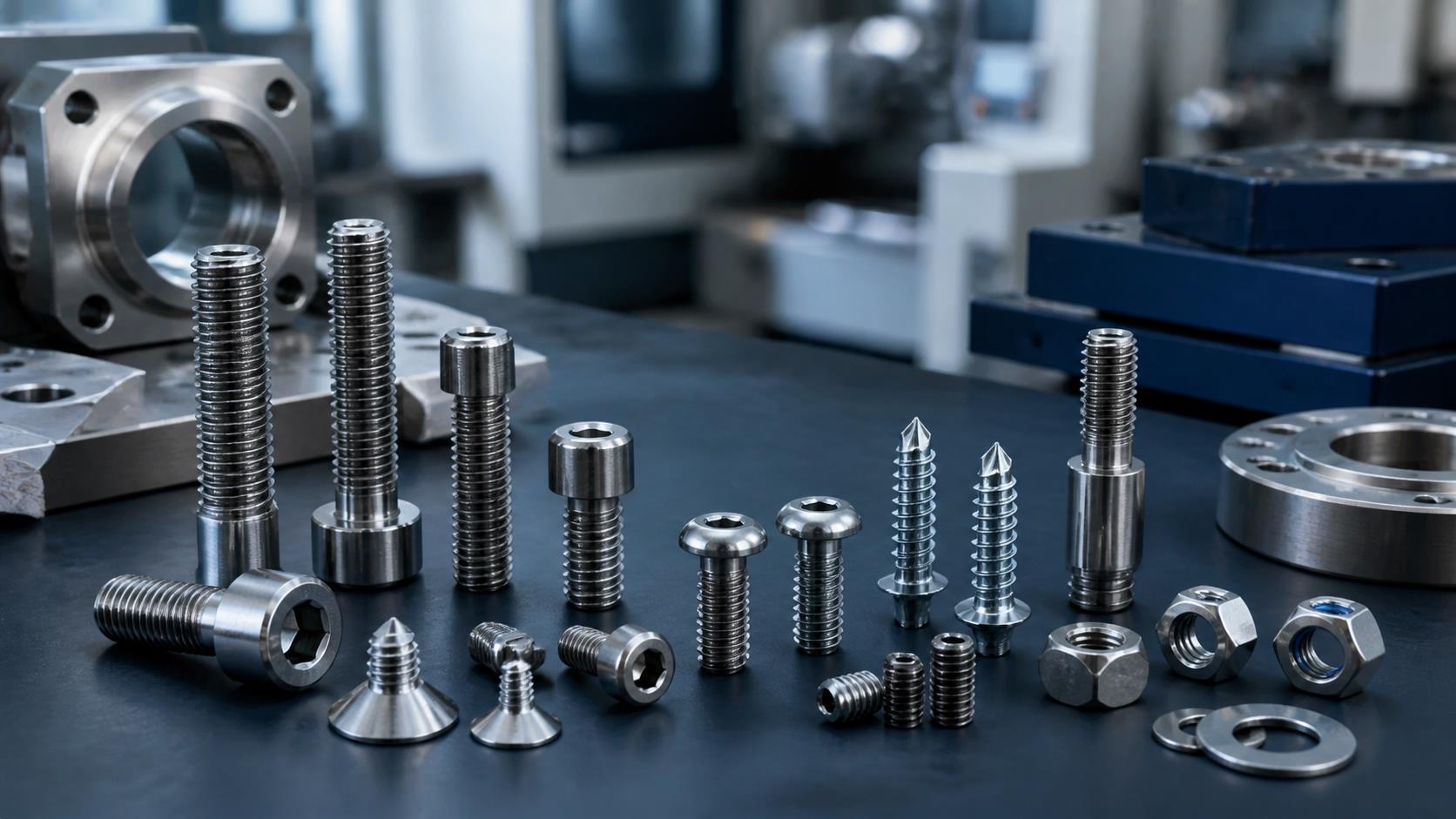
1. Basic Parts of a Screw
Head and Drive
The head transfers torque and provides a bearing surface. The drive determines the tool and resistance to cam-out.
Shank and Thread
The shank carries load while the thread converts torque into axial clamping force.
Point
The point can enter a prepared thread, form a thread or drill and cut material.
2. Common Types of Screws and Their Uses
| Type | Key feature | Typical use |
|---|---|---|
| Machine screw | Uniform thread for a nut or tapped hole | Machinery and electronics |
| Socket head cap screw | High torque internal hex drive | Fixtures, dies and machine tools |
| Self-tapping screw | Forms or cuts a mating thread | Sheet metal and plastics |
| Self-drilling screw | Creates its own hole and thread | Frames and sheet assemblies |
| Set screw | Headless pressure fastener | Gears and collars on shafts |
| Shoulder screw | Precision bearing shoulder | Guides, pivots and molds |
| Thumb screw | Manual tightening head | Adjustable covers and clamps |
| Wood screw | Coarse thread and pointed tip | Furniture and timber |
| SEMS screw | Captive preassembled washer | Efficient automated assembly |
3. Screw Head and Drive Styles
Pan and Button Head
Rounded heads offer a broad bearing surface and clean appearance.
Flat Countersunk Head
The conical underside seats flush with the component surface.
Socket and Hex Head
Industrial styles support high torque and reliable engagement.
Phillips, Torx and Security
Phillips is economical, Torx reduces cam-out, and security drives control access.
4. Thread and Tip Designs
Fine pitch supports precise adjustment, while coarse pitch is faster to assemble and better suited to softer materials. Machine threads use a nut or tapped hole. Thread-forming screws displace material without chips, while thread-cutting screws remove material. Point styles include cup, cone, dog, flat, sharp and drill points.
5. Materials and Surface Finishes
Steel
Carbon and alloy steels provide cost-effective strength. Zinc plating or black oxide can add protection.
Stainless Steel
Offers strong corrosion resistance, but thread galling may require suitable lubrication.
Brass and Aluminum
Useful where conductivity, appearance or low weight matters. Verify strength and galvanic compatibility.
6. How to Select the Right Screw
Define the joint loads: tensile, shear, vibration, impact and fatigue.
Check the mating material: metals, plastics and wood need different threads and pilot holes.
Select diameter and engagement: confirm strength without weakening thin walls.
Choose the head and drive: consider space, surface, torque and service access.
Match the environment: account for moisture, chemicals, temperature and galvanic corrosion.
Control installation: specify torque, lubrication, locking and inspection.
Verify standards: confirm dimensions, tolerance class, grade and traceability.
Frequently Asked Questions
What is the difference between a screw and a bolt?
A screw usually engages an internal thread or forms its own. A bolt commonly passes through clearance holes and tightens with a nut.
When should a fine thread be used?
Fine threads suit precise adjustment, limited depth and high tensile loading, but are more sensitive to dirt and cross-threading.
How can screw loosening be reduced?
Create adequate preload and select a locking method appropriate for the joint and service environment.
Can Zentoc manufacture custom threaded components?
Zentoc supports precision CNC machining for threaded parts, inserts, shafts, housings and mating components.
Need Precision Threaded Parts or Custom Fastener Components?
Zentoc provides CNC machining and custom manufacturing support for precision metal components and production assemblies.
Contact Zentoc