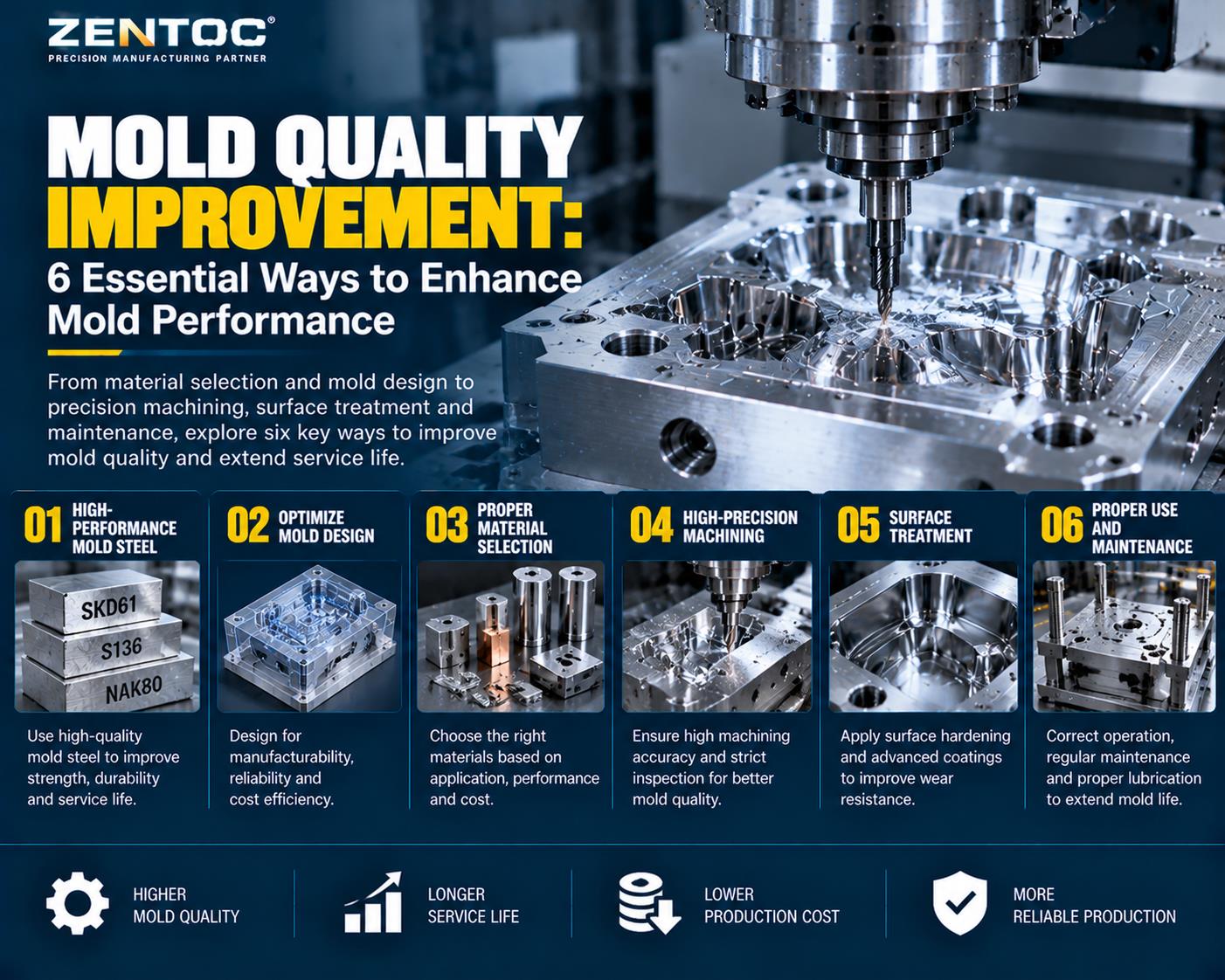
Manufacturers must deliver customized, high-quality products at lower cost and within shorter lead times. Mold quality directly affects part quality, output, production cost, product launch schedules, flexibility and market competitiveness.
This guide explains six practical ways to improve mold quality, helping molds produce qualified parts for more cycles while maintaining precision, efficiency and a longer service life.
1. Why Mold Quality Matters in Competitive Manufacturing
A mold must do more than create the correct geometry during an initial trial. It must maintain accuracy, movement, cooling and surface performance across repeated production cycles.
1.1 Product Quality
Cavity accuracy, surface condition, temperature balance and mold movement determine molded-part dimensions and appearance.
1.2 Production Efficiency
Reliable cooling, ejection and moving mechanisms support shorter cycles and fewer interruptions.
1.3 Lifecycle Cost
Longer service life, easier repair and preventive maintenance reduce downtime and total ownership cost.
2. Develop and Adopt High-Performance Mold Steel
Steel production consumes energy and resources. Improving steel strength, cleanliness, wear resistance and dimensional stability can reduce the material required and extend component life.
2.1 Reduce Material Consumption
Higher-performance steel may allow lighter or more compact components while still meeting load and service-life requirements.
2.2 Improve Mold Performance
Suitable high-strength steel can improve wear resistance, toughness and dimensional stability.
2.3 Extend Service Life
Better material performance can reduce replacement, maintenance frequency and production downtime.
2.4 Support Resource Efficiency
Using less steel per application can reduce resource consumption across the manufacturing process.
| Material Strategy | Source Example | Important Qualification |
|---|---|---|
| Replace lower-grade steel with suitable medium- or high-grade mold steel | Approximately 10-20% material reduction in certain applications | Depends on design, steel grade, load and service-life requirements |
| Use lightweight high-strength alloy tool steel for mold bases | Approximately 30-50% material reduction in suitable designs | Must be verified for stiffness, strength, stability and operating conditions |
3. Optimize Part Design and Mold Structure
Part designers must consider both product function and manufacturability. A well-designed part and mold simplify machining, fitting, assembly, molding and maintenance.
3.1 Part Geometry
Avoid unnecessary complexity that makes cavity machining, filling or ejection difficult.
3.2 Material Behavior
Account for shrinkage, molding temperature, elasticity and deformation during cooling and release.
3.3 Mold Manufacturability
Ensure cavities, cores, inserts and other components can be machined, inspected and assembled accurately.
3.4 Operating Reliability
Evaluate mold opening and closing, sliders, lifters, ejection and cooling during design.
3.5 Maintenance Access
Make wear-prone and frequently serviced components easy to inspect and replace.
3.6 Lifecycle Efficiency
Early design optimization prevents manufacturing problems and supports stable production.
4. Select Suitable Mold Steel and Design for Reliability
Mold steel selection should match product quality, expected volume, operating conditions, mold structure, failure risks and total lifecycle cost.
4.1 Plastic and Surface Requirements
Highly polished parts need clean, polishable steel; corrosive materials may require corrosion resistance or protective treatment.
4.2 Strength and Toughness
The steel must resist impact, bending, fatigue and cracking under actual molding conditions.
4.3 Rounded Transitions
Replace sharp internal corners with suitable radii where possible to reduce stress concentration.
4.4 Insert and Segmented Design
Replaceable inserts can reduce localized stress, simplify manufacture and make repair more economical.
4.5 Slender Core Protection
Long punches and cores may need added support or protection against bending and breakage.
4.6 Service-Friendly Structure
Minimize the number of parts that must be removed to replace one wear component.
Sliding and impact-loaded mechanisms should also be designed for wear, lubrication, alignment and repeatable movement.
5. Improve Mold Machining Accuracy and Inspection
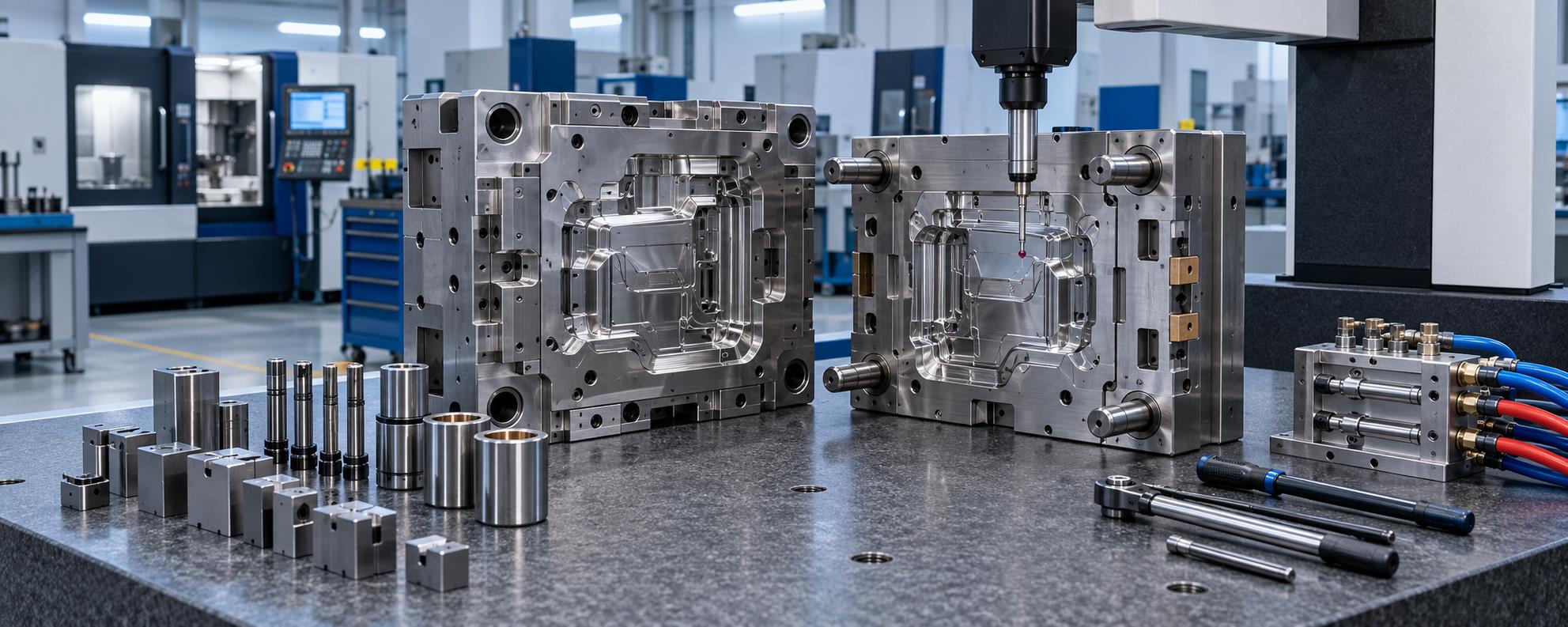
Accurate components do not automatically create an accurate assembly. Precision mold manufacturing must coordinate machining, fitting, alignment, assembly inspection and mold trials.
| Manufacturing Process | Typical Role in Mold Production |
|---|---|
| CNC machining | Machining mold plates, cavities, cores, inserts and reference features |
| Sinker EDM | Producing deep, narrow or complex cavities and sharp internal features |
| Wire EDM | Cutting precision profiles, inserts, punches and through-features |
| Precision grinding | Creating accurate flat, parallel and fitted surfaces |
| Specialized finishing | Meeting demanding surface and dimensional requirements where needed |
5.1 Critical Dimensions
Inspect dimensions and geometry that control part quality, fit and mold movement.
5.2 Core and Cavity Alignment
Verify positional relationships that determine wall thickness and parting-line quality.
5.3 Fits and Clearances
Check guide components, inserts, slides, lifters and ejectors under assembled conditions.
5.4 Opening and Closing Tests
Confirm sequence, travel, interference and reliable return of moving components.
5.5 Trial Molding
Use molded parts and machine behavior to verify the complete mold system.
5.6 Precision Measurement
Use CMMs and suitable metrology for complex curves that cannot be measured reliably with ordinary hand tools.
6. Strengthen Mold Surfaces and Forming Components
Appropriate mold surface treatment can reduce wear and help critical components maintain dimensions over repeated cycles.
6.1 Match the Failure Mechanism
Select treatment according to abrasion, adhesion, corrosion, impact, friction and temperature.
6.2 Coating Adhesion
The protective layer must bond strongly with the base material under operating loads.
6.3 Hardness and Wear Resistance
Surface hardening or coatings should improve life without creating brittle or unstable behavior.
6.4 Friction and Release
Lower friction may improve movement and part release when compatible with the molding process.
6.5 FCVA DLC Technology
Filtered cathodic vacuum arc diamond-like carbon films can form smooth, dense coatings with strong adhesion for selected applications.
6.6 Cost vs. Life Improvement
Evaluate treatment cost against expected reduction in wear, repair and downtime.
7. Use and Maintain Molds Correctly
Even a well-designed mold can fail prematurely if installation, commissioning, operation or maintenance is incorrect.
7.1 Installation and Commissioning
Follow mold requirements and machine instructions. Confirm setup, clamping and operating compatibility.
7.2 Hot Runner and Cooling
Verify electrical connections, temperature control, circuit connections and cooling performance before production.
7.3 Lubrication
Lubricate guide pillars, bushes, slides and other moving parts at suitable intervals.
7.4 Release Agents
Use process-compatible lubrication or release agents on forming surfaces only when required.
7.5 Cleaning and Rust Prevention
Clean and dry the mold after use, then protect cavities, cores, guides and exposed precision surfaces.
7.6 Maintenance Records
Track wear, defects, repairs, trial results and replacement history to improve troubleshooting.
Preventive Mold Maintenance Checklist
| Maintenance Activity | Purpose |
|---|---|
| Cleaning and inspection after production | Remove contamination and identify early damage |
| Lubrication of moving components | Reduce friction and maintain accurate movement |
| Rust prevention and controlled storage | Protect forming and precision surfaces |
| Cooling-channel inspection | Prevent scale, blockage, leakage and temperature imbalance |
| Hot-runner inspection | Maintain heating, wiring, sealing and flow reliability |
| Wear-component monitoring | Replace parts before they affect quality or damage the mold |
| Maintenance documentation | Support faster diagnosis and continuous improvement |
8. Coordinate Quality Across the Mold Lifecycle
No single measure guarantees superior mold performance. The strongest results come from coordination among product design, mold engineering, machining, fitting, inspection, production and maintenance teams.
8.1 Before Manufacturing
Define quality, volume, material, cycle time, surface and service-life requirements.
8.2 During Manufacturing
Control material, machining references, heat treatment, fitting, assembly and inspection.
8.3 During Production
Monitor mold movement, cooling, part quality, wear, downtime and recurring defects.
Conclusion
Improving mold quality requires a systematic approach. The six essential methods are adopting high-performance steel, optimizing product and mold design, selecting suitable steel and reliable structures, improving machining and inspection, strengthening mold surfaces, and using and maintaining molds correctly.
Coordinating these measures helps manufacturers extend mold service life, preserve accuracy, reduce unnecessary cost and produce high-quality parts consistently.
Mold Quality Improvement FAQ
What is the most effective way to improve mold quality?
No single action is enough. Material, design, machining, inspection, surface treatment, operation and maintenance must be managed as one lifecycle.
Can higher-performance mold steel reduce material use?
In suitable designs it may. The source provides examples of 10-20% or 30-50% reductions, but actual results depend on steel, structure, load and service-life requirements.
Why is CMM inspection important for molds?
A coordinate measuring machine can verify complex curves, position and geometry that ordinary hand tools may not measure reliably.
How does surface treatment extend mold life?
A suitable treatment can improve hardness, wear resistance, corrosion protection, friction behavior and dimensional retention.
What should a mold maintenance program include?
Cleaning, inspection, lubrication, rust protection, cooling and hot-runner checks, wear monitoring and documented repair history.
Need High-Quality Custom Mold Manufacturing?
Zentoc provides mold design, precision mold manufacturing, CNC machining, EDM and customized production solutions.
Contact Zentoc