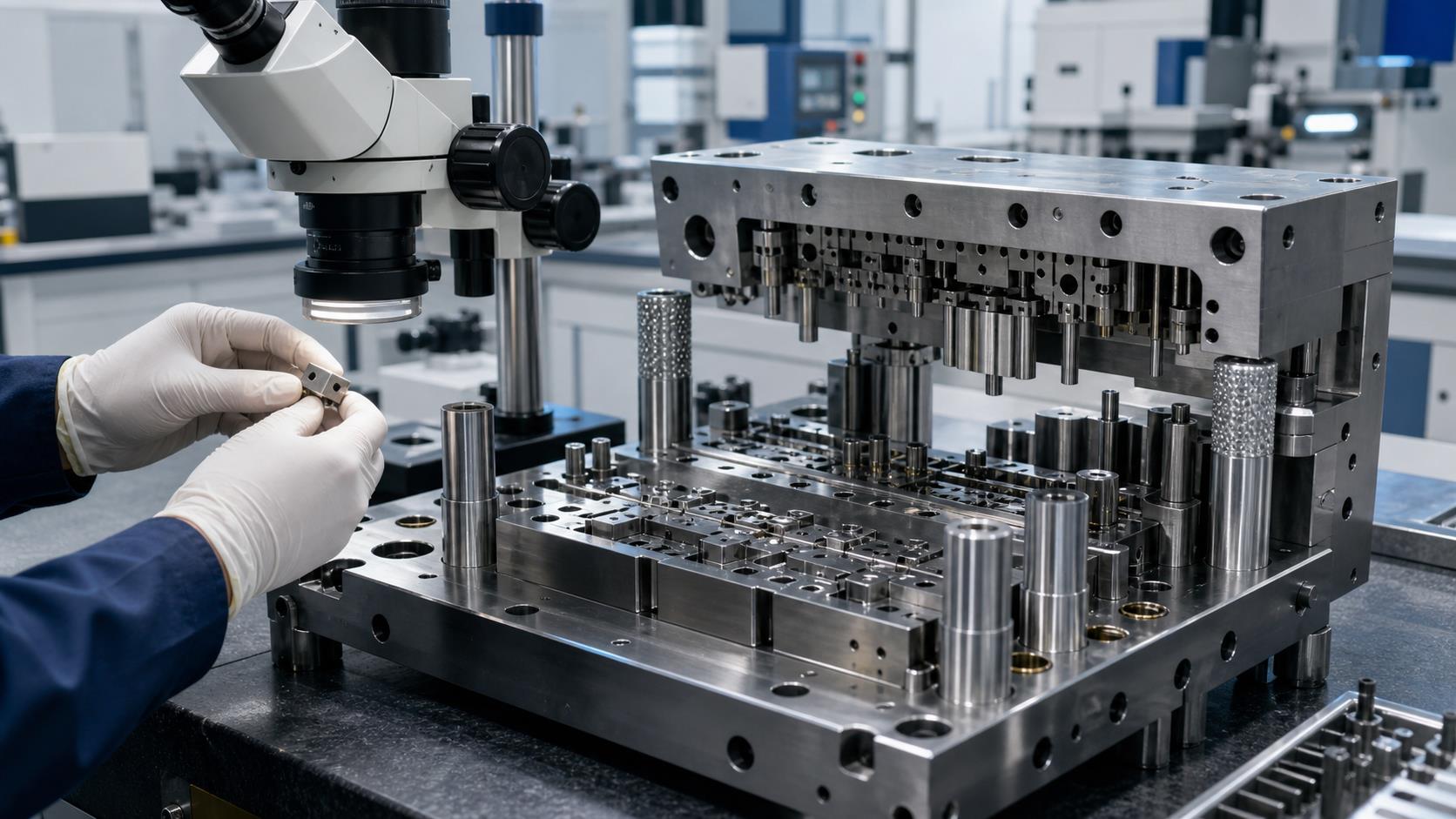
A precision mold is assembled from many individual components, and the accuracy and surface quality of those parts determine the quality of the finished mold. Because final dimensions, geometry and surface integrity are established mainly during finishing, precision mold finishing is a critical stage of mold manufacturing.
This guide explains practical controls for heat treatment, precision grinding, wire EDM, sinker EDM, surface treatment and final mold assembly.
1. Precision Mold Manufacturing Process
Mold components can generally be grouped as plate-type, irregularly shaped and shaft-type parts. Each geometry requires different finishing and inspection controls.
1.1 Plate Components
Mold plates, inserts and long thin parts require careful control of flatness, parallelism and magnetic-clamping deformation.
1.2 Irregular Components
Complex profiles often combine grinding, wire EDM, sinker EDM and manual finishing to achieve final geometry.
1.3 Shaft Components
Rotational parts depend on center accuracy, spindle condition, controlled clamping and sufficient coolant during grinding.
2. Heat Treatment of Precision Mold Components
Heat treatment must provide the required hardness while controlling internal stress so the workpiece remains dimensionally stable during finishing and mold service.
| Material or Condition | Reference Process | Main Objective |
|---|---|---|
| Cr12MoV | Quench at about 900-1020 degrees C; cool to about 200-220 degrees C; air cool; temper promptly around 220 degrees C | High strength and wear resistance while relieving quenching stress |
| V10 or ASP23 powder metallurgy steel | Quench at about 1050-1080 degrees C; use multiple tempering cycles at about 490-520 degrees C | Secondary hardening, impact toughness and dimensional stability |
| Complex geometry | Add stress-relief annealing or multiple aging treatments before finishing | Release residual stress not eliminated by ordinary tempering |
2.1 Cr12MoV Components
Quenching follows rough machining. Because substantial residual stress can remain, temper promptly to reduce cracking risk during grinding or mold operation. The single-hardening approach suits molds where wear is the main failure mode.
2.2 Powder Metallurgy Tool Steel
V10 and ASP23 tolerate high-temperature tempering and provide favorable toughness and dimensional stability. Although more expensive, they suit punches and dies exposed to high load and edge-chipping risk.
3. Precision Grinding of Mold Components
Surface grinders, internal and external cylindrical grinders, and tool grinders are widely used for precision mold finishing. Grinding deformation, cracks and burn must be controlled because small defects can grow during later machining or mold operation.
3.1 Infeed and Coolant
Use small finish-grinding infeed and sufficient coolant. Aggressive removal increases heat, deformation, cracking and surface-integrity risk.
3.2 Temperature Stability
Components with tolerances within 0.01 mm should be ground under stable temperature conditions. A 300 mm steel part with a 3 degrees C temperature difference may change by about 10.8 micrometers.
3.3 Grinding Wheel Selection
GD single-crystal alumina can suit high-vanadium and high-molybdenum steel. Organic-bond diamond wheels are preferred for cemented carbide and very hard materials.
3.4 Wheel Dressing
Dress wheels regularly. A dull wheel rubs and squeezes instead of cutting, creating grinding burn and reducing surface integrity.
CBN wheels can provide excellent results on CNC form grinders, jig grinders and precision cylindrical grinders. Suitable diamond grinding may achieve approximately Ra 0.2 micrometers.
4. Grinding Thin Plate-Type Mold Components
Long, thin plates can deform against a magnetic chuck. Thickness may appear consistent while the part springs back after release and fails the required parallelism.
This approach reduces magnetic-chuck conformity and improves final flatness and parallelism.
5. Grinding Shaft-Type Mold Components
5.1 Inspect the References
Check the grinder headstock and centers before finishing. Their runout can transfer directly to the component.
5.2 Supply Coolant Correctly
During internal grinding, direct sufficient coolant into the grinding contact area to remove chips and abrasive debris.
5.3 Control Clamping Force
Use dedicated clamping for thin-wall shafts. Excessive force can produce a three-lobed or triangular circumferential distortion.
5.4 Match the Machine
Use internal or external cylindrical grinders or tool grinders according to rotational geometry, tolerance and surface requirements.
6. Wire EDM Process Control
Wire EDM machines hardened and complex mold components that are difficult to cut conventionally. Slow-speed wire EDM may achieve about plus or minus 0.003 mm dimensional accuracy and surface roughness around Ra 0.2 micrometers under suitable conditions.
6.1 Check Machine Conditions
Verify water deionization, water temperature, wire verticality, wire tension and other stability factors before cutting.
6.2 Control Residual Stress
Wire cutting changes stress equilibrium, especially near corners below about 0.2 mm radius. Review sharp corners and consider pre-machining with about 1 mm stock followed by stress relief before final cutting.
6.3 Plan Wire Entry
For punches, begin through a prepared threading hole where practical. This improves entry control and protects critical edges.
6.4 Use Multiple Passes
Approximately four passes may be used for high-precision wire EDM. For tapered dies, combine rough straight cutting, taper cutting and final straight-edge finishing.
7. Sinker EDM and Electrode Manufacturing
Sinker EDM uses roughing and finishing electrodes. Finishing electrodes require high geometric accuracy and shape conformity and should be CNC machined whenever practical.
7.1 Copper Electrodes
Copper is commonly used for conventional steel mold components and general sinker EDM applications.
7.2 Copper-Tungsten Electrodes
Copper-tungsten provides lower wear and suits difficult materials and complex cross sections when flushing is sufficient.
7.3 Spark Gap Planning
Calculate the required spark gap and electrode quantity before manufacturing. Separate roughing and finishing electrodes where necessary.
7.4 Rigidity and Flushing
Clamp large or heavy electrodes securely. Deep-step EDM requires careful flushing to avoid uneven wear and arcing.
8. Surface Treatment of Precision Mold Components
Tool marks, grinding lines and sharp edges can create stress concentrations and crack origins. Bench finishing and polishing should remove defects, while edges, corners and hole entrances should be deburred and given suitable radii.
9. Demagnetization and Mold Assembly
Grinding and EDM can leave weak residual magnetism that attracts metallic particles. Demagnetize components and clean every surface before assembly.
Review the assembly drawing, prepare all parts and define critical inspection points before work begins. Punch-to-die clearance requires particular attention. Document the completed mold condition after comprehensive inspection.
10. Precision Mold Quality Control
| Process | Critical Control | Quality Risk |
|---|---|---|
| Heat treatment | Hardness, tempering, stress relief and aging | Cracking and dimensional instability |
| Precision grinding | Temperature, infeed, wheel condition and coolant | Burn, cracks, distortion and poor finish |
| Wire EDM | Machine condition, residual stress, corner radius and toolpath | Dimensional change and stress concentration |
| Sinker EDM | Electrode accuracy, spark gap, rigidity and flushing | Wear, arcing and geometry error |
| Surface finishing | Remove defects and altered EDM layer | Crack initiation and reduced service life |
| Assembly | Cleanliness, demagnetization, alignment and clearance | Contamination, poor motion and mold failure |
If a problem appears, trace the process backward from assembly and finishing toward earlier operations until the root cause is identified.
Conclusion: Precision Mold Finishing Determines Final Quality
Successful precision mold manufacturing depends on controlled finishing, not rough machining alone. Heat treatment establishes hardness and stress condition; grinding establishes dimensions and surface quality; EDM produces hardened complex geometry; surface treatment removes harmful layers; and careful assembly transfers individual part accuracy into the complete mold.
Consistent control of these processes reduces scrap, improves first-pass mold success and extends mold service life.
Precision Mold Finishing FAQ
Why is tempering required after quenching mold components?
Tempering reduces quenching stress and helps prevent cracking or dimensional change during precision finishing and mold service.
How does temperature affect precision grinding accuracy?
Steel expands with temperature. Even a few degrees of difference can create dimensional changes larger than a tight mold tolerance.
Why can magnetic-chuck grinding distort thin plates?
The magnetic force can flatten a warped plate during grinding. After release, elastic recovery returns the distortion and reduces parallelism.
Why are multiple wire EDM passes used?
Roughing removes most material, while later passes improve dimensional accuracy, edge quality and surface finish.
Why must EDM surfaces be polished before service?
EDM can leave a brittle altered layer with residual stress. Removing it reduces crack-initiation risk.
Need Precision Mold Components?
Zentoc provides precision grinding, EDM, wire EDM, CNC machining and custom mold component manufacturing.
Contact Zentoc