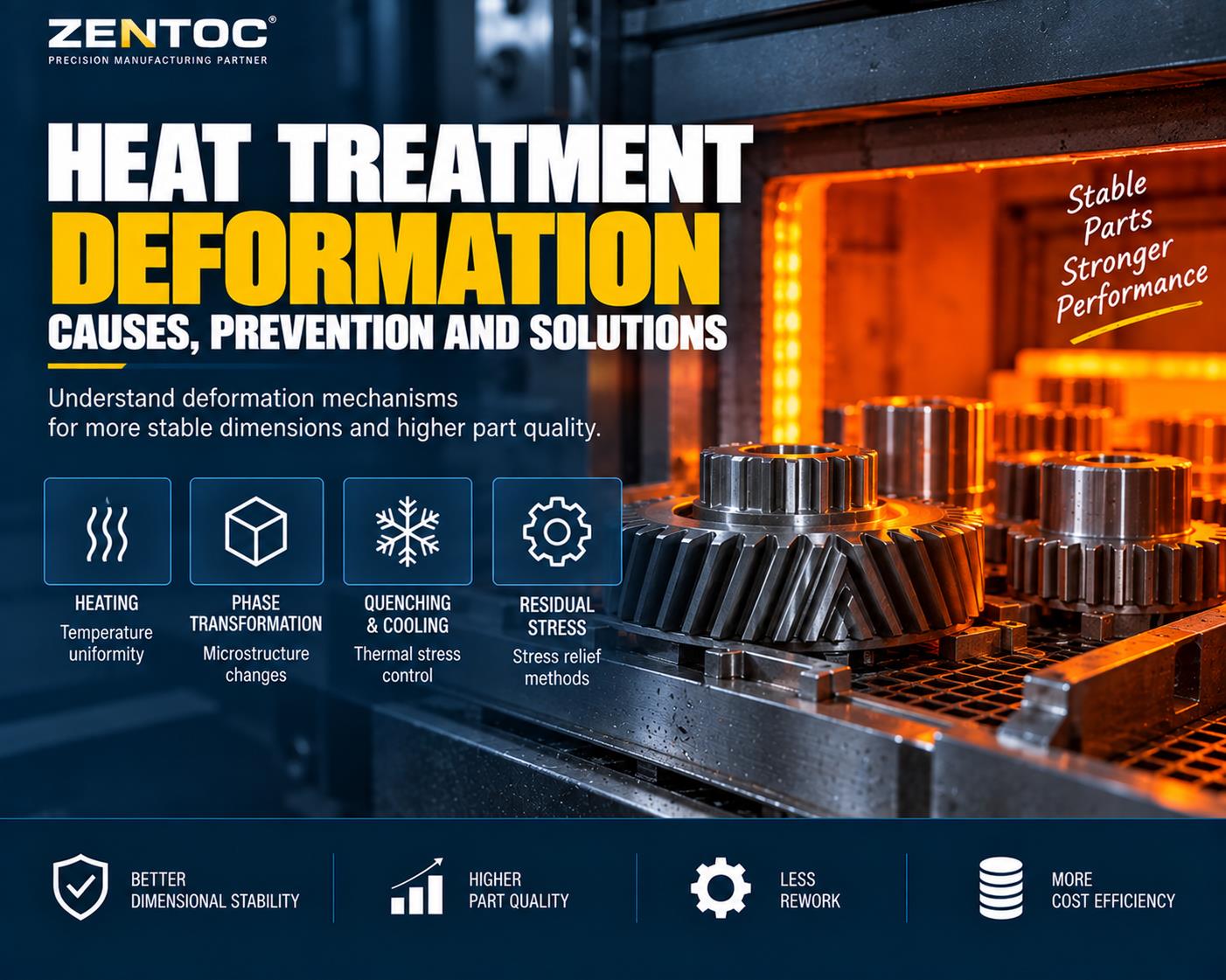
Heat treatment deformation is a common challenge in precision manufacturing, mold making, tool production and CNC machining. Heating, soaking, quenching, tempering and cryogenic treatment can cause dimensional changes, warping, bending or cracking in steel components.
Understanding residual stress, thermal stress and phase transformation stress helps manufacturers reduce quenching distortion, minimize rework and improve dimensional stability.
1. Main Causes of Heat Treatment Deformation
1.1 Internal Stress
Uneven temperature, phase transformation and residual stress from machining or forming can create internal forces that distort the workpiece.
1.2 External Stress
Workpiece weight may cause sagging at elevated temperature. Impact, incorrect support or indentation from clamping tools can also create distortion.
1.3 Elastic Deformation
Elastic dimensional change may recover when the applied stress is removed, provided material yield strength has not been exceeded.
1.4 Plastic Deformation
When stress exceeds the reduced high-temperature yield strength, permanent warping, bending or dimensional change can remain after cooling.
Microstructural change mainly causes expansion or contraction, but holes, cavities and complex cross sections can turn these dimensional changes into additional shape distortion.
2. When Does Quenching Deformation Occur?
| Heat Treatment Stage | Main Deformation Mechanism | Typical Risk |
|---|---|---|
| Heating | Residual-stress release, uneven thermal expansion and phase transformation | Warping or permanent dimensional change |
| Soaking | Reduced material strength combined with workpiece weight | Sagging and support-related distortion |
| Cooling and quenching | Uneven cooling plus transformation stress | Major distortion, residual stress or cracking |
| Tempering | Stress redistribution and microstructure change | Usually shrinkage; secondary-hardening steel may expand |
| Cryogenic treatment | Retained austenite transforms to martensite | Additional expansion and possible cracking |
3. Heating and Heat Treatment Deformation
Residual stresses are introduced by forming, machining, welding and previous thermal processes. As steel temperature rises, yield strength decreases, so even modest residual stress can deform the softened material.
Residual stress is often high near the outside of a workpiece, and heating usually begins at the surface. Outer regions may therefore deform before the core reaches a similar temperature. Large components and parts with major cross-section changes are especially sensitive.
4. Thermal Stress During Heating
4.1 Heating Rate
Faster heating increases the temperature difference between the workpiece surface and core.
4.2 Workpiece Size
Large sections require more time to equalize and can develop greater internal temperature gradients.
4.3 Section Changes
Thin and thick regions heat and expand at different rates, producing uneven stress and localized deformation.
If thermal stress exceeds the material's high-temperature yield strength, plastic deformation occurs and remains after heat treatment.
5. Phase Transformation Stress
Phase transformation stress develops when different regions transform at different times. During heating, transformation to austenite causes volume contraction. If the entire component transformed simultaneously, significant transformation stress would be much less likely.
5.1 Martensite
A large amount of martensite after quenching normally causes workpiece expansion.
5.2 Retained Austenite
A greater retained-austenite fraction can be associated with corresponding shrinkage.
5.3 Carbon Content
The specific volume of these microstructures generally rises with carbon content, increasing potential dimensional change.
5.4 Secondary Hardening
Tempering normally causes shrinkage, but alloy steels undergoing secondary hardening may expand.
6. Cooling and Quenching Deformation
The surface and core cool at different rates, so thermal stress during cooling is difficult to eliminate. Quenching combines this thermal stress with phase transformation stress, making the deformation mechanism more complex.
Microstructure variations, decarburization and other material differences can change local transformation temperature and expansion. Some stress is released through distortion; the remainder becomes residual stress that may later cause dimensional drift or aging-related cracking.
7. Typical Quenching Deformation Patterns
7.1 Uneven Surface Cooling
The faster-cooled side may initially become concave and later become convex. If thermal stress dominates, that side remains convex.
7.2 Overall Shape Change
Thermal stress tends to drive steel toward a more spherical form, while transformation stress tends to create a spool-like shape. Actual distortion usually combines both.
7.3 Ring and Hole Distortion
Quenching only an inner hole tends to shrink it. A fully quenched ring generally expands outside, while its inside diameter may expand or shrink depending on dimensions.
8. Cryogenic Treatment and Deformation
Cryogenic treatment transforms retained austenite into martensite, which can cause additional expansion. Because the process occurs at low temperature, deformation is generally smaller than during quenching.
Residual, thermal and transformation stresses can still combine and raise cracking risk. Precision components should therefore be evaluated for both dimensional change and fracture risk before cryogenic treatment.
9. Tempering and Deformation
Tempering redistributes and reduces internal stress while stabilizing the microstructure, so the tendency for later deformation normally decreases. However, significant distortion that already occurred during quenching can be difficult to correct.
Press tempering, shot peening or other controlled correction methods may help selected shapes and materials, but prevention is generally more reliable than post-process correction.
10. Repeated Quenching and Deformation
Repeated quenching without intermediate annealing usually accumulates distortion and increases cracking risk. The workpiece may gradually approach a more spherical shape, even if later dimensional changes become smaller.
11. Residual Stress and Dimensional Stability
Residual stress is a major factor in heat treatment deformation. Around 450 degrees C, steel becomes increasingly plastic, and residual stresses can begin to disappear as recrystallization progresses.
During rapid heating, the surface can reach this softened condition while the cooler core still retains stress. Stress in the core then acts on the more plastic outer region, creating permanent distortion after cooling.
11.1 Stress-Relief Annealing
Reducing residual stress before quenching is especially important when perfectly slow and uniform heating is impractical.
11.2 Vibration Stress Relief
For selected large components, vibration stress relief may supplement thermal stress-relief methods.
12. How to Reduce Heat Treatment Deformation
| Control Measure | Purpose |
|---|---|
| Stress-relief treatment before quenching | Reduce residual stress from machining, forming or welding |
| Preheating and controlled heating rate | Reduce surface-to-core temperature gradients |
| Avoid excessively rapid heating | Limit thermal stress in large or complex parts |
| Provide suitable support during soaking | Prevent sagging under the workpiece's own weight |
| Improve cooling uniformity | Reduce thermal and transformation stress differences |
| Plan for structural volume change | Account for martensite, retained austenite, tempering and cryogenic effects |
| Use intermediate annealing | Limit accumulated distortion during repeated quenching |
| Consider vibration stress relief | Reduce residual stress in suitable large components |
Heat treatment deformation control must begin with material selection, part design and rough machining, then continue through fixturing, heating, cooling, tempering and final dimensional stabilization.
Conclusion
Heat treatment deformation results from interactions among residual stress, thermal stress, phase transformation stress, heating rate, cooling uniformity, geometry, carbon content and treatment conditions.
Controlling residual stress before heat treatment, using appropriate preheating, supporting the component correctly and maintaining uniform cooling can reduce dimensional change and improve stability in precision parts and mold components.
Heat Treatment Deformation FAQ
What are the main causes of heat treatment deformation?
The main causes are residual stress, uneven temperature, thermal stress, phase transformation stress and external loads such as workpiece weight or poor clamping.
At which stage does quenching distortion occur?
Deformation can begin during heating, continue during soaking and become most complex during cooling and phase transformation.
Why does martensite cause dimensional expansion?
Martensitic transformation increases material specific volume, so a large amount of martensite generally expands the workpiece.
How can residual stress be reduced before quenching?
Stress-relief annealing is commonly used, while vibration stress relief may be suitable for some large components.
Does tempering eliminate existing distortion?
Tempering reduces and redistributes internal stress, but significant deformation that already occurred can be difficult to correct.
Need Dimensionally Stable Precision Components?
Zentoc provides precision CNC machining and custom manufacturing with process planning for demanding metal components.
Contact Zentoc