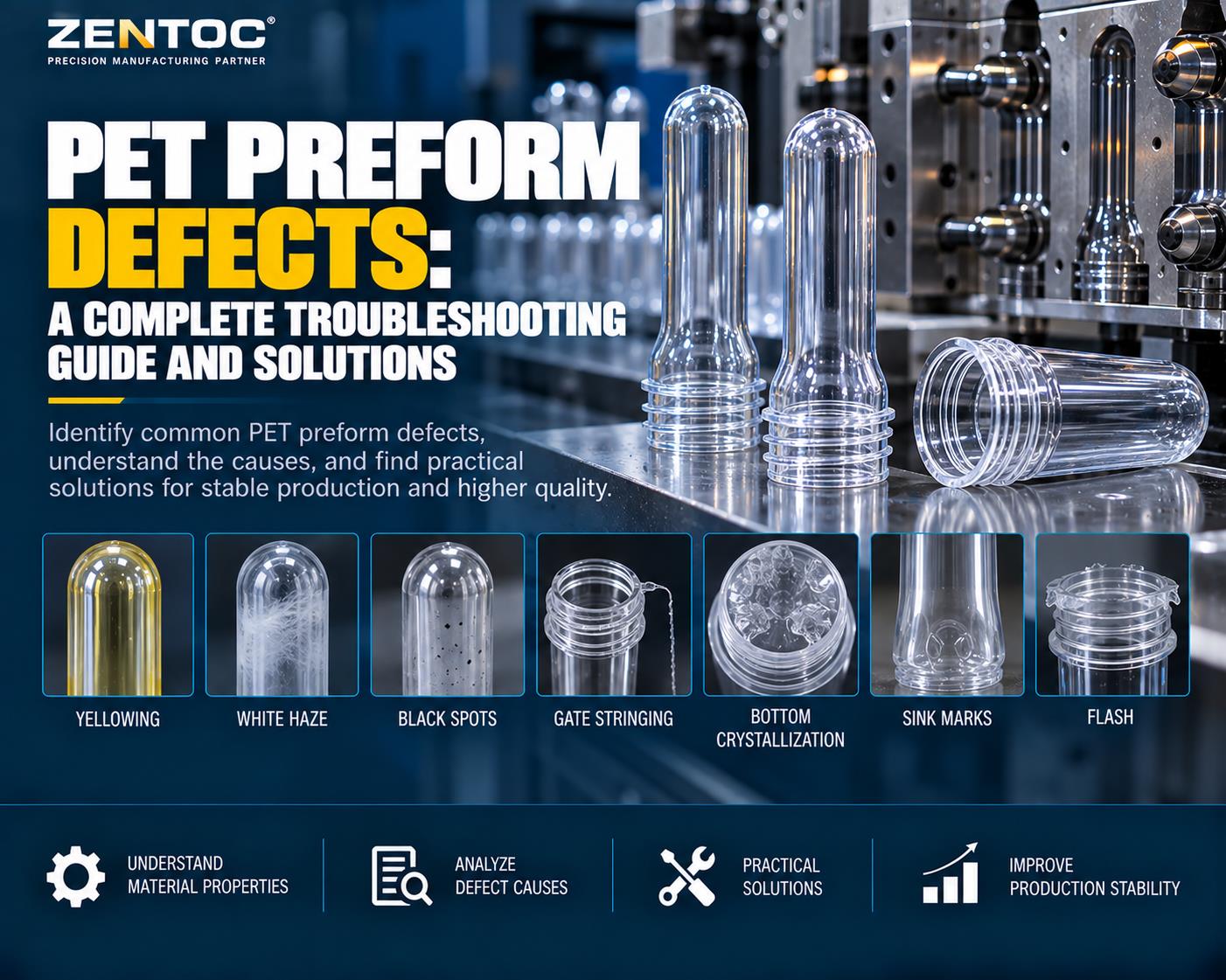
Producing high-quality PET preforms requires precise control of resin drying, material temperature, injection and holding parameters, mold cooling, hot-runner temperature and cycle time. Small variations can cause yellowing, shrinkage, haze, black spots, flash, gate stringing, crystallization and excessive acetaldehyde.
This guide explains PET preform injection molding, recommended PET drying conditions, cycle optimization and practical solutions for 21 common PET preform defects.
1. PET Material Properties and Packaging Applications
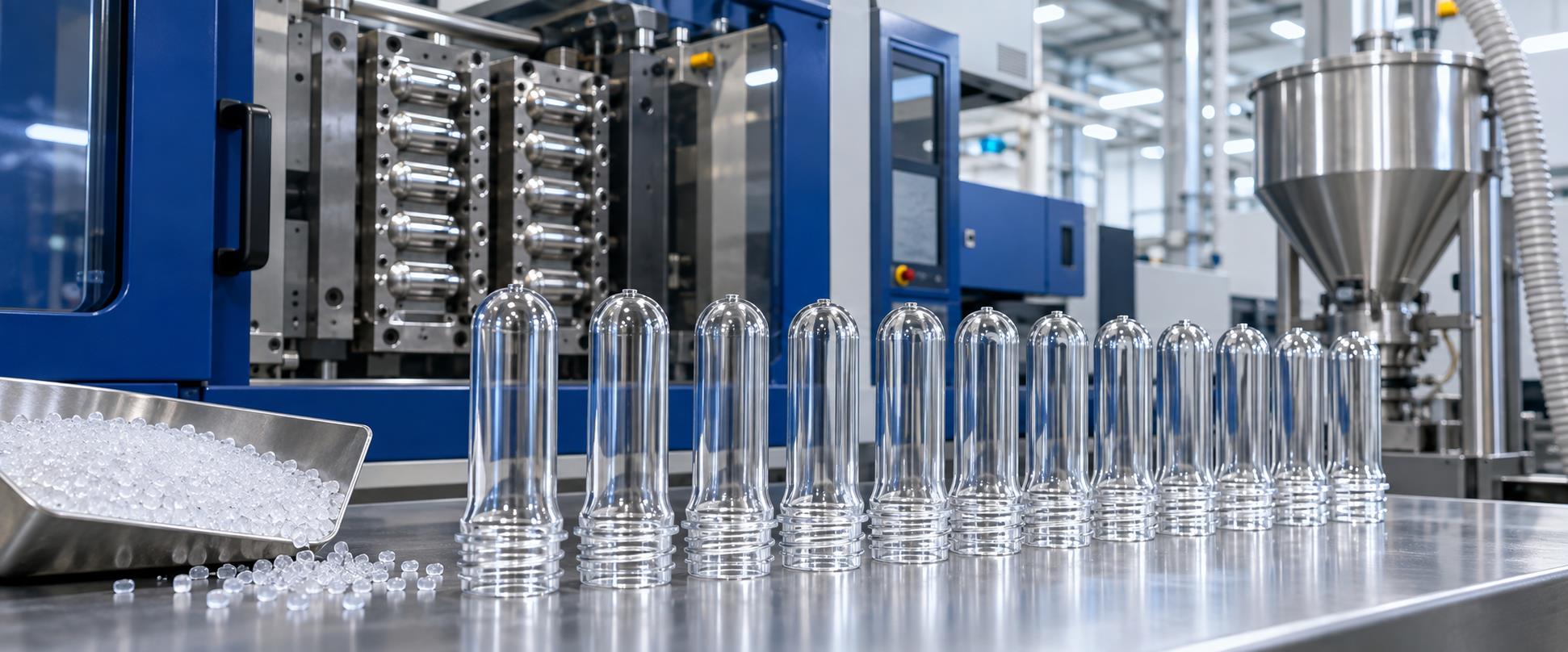
PET stands for polyethylene terephthalate. It is a polyester widely used for beverage bottles and other packaging because it combines clarity, gloss, chemical resistance, gas-barrier performance and mechanical strength.
1.1 Optical Quality
PET can achieve approximately 90% or higher transparency with a glass-like surface appearance.
1.2 Barrier Performance
Good aroma retention and gas-barrier properties help protect packaged products.
1.3 Mechanical Strength
Strong mechanical performance can be enhanced through biaxial stretching during bottle production.
2. PET Resin Drying Requirements
Untreated PET pellets may contain about 0.1-0.3% moisture, or 1,000-3,000 ppm. Moisture can hydrolyze PET during processing, raise acetaldehyde (AA), lower intrinsic viscosity (IV), and reduce final bottle strength.
| PET Drying Parameter | Recommended Setting | Why It Matters |
|---|---|---|
| Drying temperature | 165-175 degrees C | Removes absorbed moisture before plasticizing |
| Residence time | 4-6 hours | Allows pellets to dry through their cross-section |
| Feed inlet temperature | Above 160 degrees C | Confirms effective heat delivery |
| Dew point | Below -30 degrees C | Maintains sufficiently dry process air |
| Drying airflow | 3.7 m3/h per kg/h | Supports moisture removal and stable throughput |
| Final moisture | 10-40 ppm, plus or minus 10 ppm | Supports stable molding while avoiding excessive drying |
3. How to Optimize the PET Preform Production Cycle
3.1 Machine and Mold Motion
Coordinate mold opening and closing speed, ejection speed, take-out plate distance and the mold position that permits robot entry.
3.2 Injection and Holding
Balance injection speed with the pressure limit, then coordinate holding pressure, holding time and transfer position.
3.3 Gate and Hot Runner
Set gate shut-off timing correctly and maintain reliable valve-pin, nozzle and cylinder operation.
3.4 Cooling Balance
Optimize cooling time while maintaining a stable average mold temperature and adequate water flow.
4. PET Preform Defects 1-5: Material and Thermal Control
4.1 Excessive AA
Check resin quality and dryer performance. Reduce excessive barrel temperature, lower screw back pressure toward the referenced 400-600 psi range, and shorten excessive residence time.
4.2 Yellow PET Preforms
Replace over-dried material, reduce excessive barrel temperature and purge heat-damaged PET that has remained in the barrel too long.
4.3 Wall-Thickness Variation
Reduce excessive screw temperature, back pressure and injection speed. Check 9-11 degrees C cooling water and allow roughly 3-4 seconds cooling where appropriate.
4.4 Surface Scratches
Clean the mold, repair damaged components, inspect take-out suction tubes and correct the neck-ring ejection and take-out plate positions.
4.5 Excessive IV Loss
Use FIFO inventory control, verify drying and desiccant condition, reduce excessive process heat and back pressure, and control warehouse humidity and temperature.
5. PET Preform Defects 6-10: Filling, Cooling and Gate Control
5.1 Shrinkage and Deformation
Increase cooling to about 3-4 seconds where needed, optimize 6-8 seconds of staged holding, and stabilize cooling water near 9-11 degrees C with adequate pressure.
5.2 Unmelted PET
Increase insufficient barrel heat, correct screw slipping, raise low back pressure and confirm material feed temperature near 160 degrees C.
5.3 Incomplete Neck Filling
Increase shot size, injection pressure and speed as required. Adjust the holding transfer position and verify cooling-water temperature.
5.4 Elongated Gate or Long Sprue
Re-dry PET, service blocked hot-runner valve-pin cylinders, lower excessive nozzle temperature, and increase insufficient holding or cooling time.
5.5 Gate Stringing
Repair worn nozzle or valve-pin components, reduce excessive nozzle heat, shorten the gate-closing delay and inspect the valve-pin control system.
6. PET Preform Defects 11-15: Moisture, Haze and Contamination
6.1 Moisture or Water Marks
Prevent mold condensation by balancing cooling-water temperature with workshop temperature and humidity, and repair any mold water leakage.
6.2 Bottom Crystallization
Increase low hot-runner or nozzle temperature, reduce excessive third-stage holding pressure, and clean blocked mold cooling circuits.
6.3 White Haze
Dry the material again, raise insufficient screw heat, correct screw slipping and increase low back pressure.
6.4 Black Spots or Contamination
Remove contaminated resin, inspect the dryer, reduce overheated barrel or hot-runner zones, and improve machine, workshop and warehouse cleanliness.
6.5 PET Preform Flash
Repair mold lip, core seat or cavity damage. Reduce excessive injection, holding pressure or temperature, and verify adequate clamping force.
7. PET Preform Defects 16-21: Bottom and Nozzle Problems
7.1 Bottom Peeling
Correct nozzle temperature, replace worn nozzle and insulation components, inspect the valve pin and reduce excessive third-stage holding pressure.
7.2 Internal Bottom Shrinkage
Clean scale from core cooling passages, secure loose cooling tubes, and restore adequate water pressure and temperature.
7.3 Burn Marks
Reduce high nozzle temperature, replace aged insulation sleeves, clean blocked cavity-bottom cooling channels and improve water flow.
7.4 Fishbone-Shaped Streaks
Reduce excessive hot-runner and nozzle temperatures, renew aged insulation and service a sticking valve pin.
7.5 Gate Pinholes
Lower nozzle and hot-runner temperature, increase decompression, re-dry PET, slow excessive injection and increase insufficient holding.
7.6 Bottom Sink Marks
Increase shot size and holding pressure, correct the holding position, lower excessive cooling-water temperature and provide enough cooling time.
8. Key Areas for PET Preform Troubleshooting
| Process Area | What to Check |
|---|---|
| PET resin drying | Moisture, temperature, time, airflow, dew point and desiccant condition |
| Material temperature | Complete melting without excessive thermal exposure, AA generation or IV loss |
| Injection and holding | Speed, pressure, back pressure, transfer position, holding stages and time |
| Hot runner and nozzle | Temperature, valve pins, cylinders, nozzles and insulation components |
| Mold cooling | Water temperature, pressure, flow and clean cooling channels |
| Cycle and cleanliness | Residence time, adequate cooling, clean material, equipment, workshop and packaging |
Identify the visible defect first, then check the related material, dryer, machine settings, hot runner, cooling system and production environment. A systematic approach is more reliable than changing several parameters at once.
Conclusion
Stable PET preform injection molding depends on the interaction of resin condition, drying performance, melt temperature, injection pressure, holding pressure, cooling, hot-runner control, cycle time and production cleanliness.
By controlling these variables and applying defect-specific corrective actions, manufacturers can reduce yellowing, white haze, shrinkage, flash, gate stringing, crystallization, black spots, burn marks, scratches and wall-thickness variation while improving PET preform quality and production consistency.
PET Preform Injection Molding FAQ
Why must PET resin be dried before injection molding?
PET absorbs moisture. At processing temperature, that moisture can cause hydrolytic degradation, higher AA and lower IV, reducing product quality and mechanical strength.
What is the recommended PET drying temperature?
The source guidance recommends 165-175 degrees C for approximately 4-6 hours, with dew point below -30 degrees C and final moisture near 10-40 ppm.
What causes yellow PET preforms?
Common causes include excessive drying, excessive barrel temperature and material remaining in the barrel too long.
How can PET preform flash be reduced?
Inspect the mold for damage, reduce excessive injection or holding pressure and process temperature, confirm clamping force, and shorten excessive material residence time.
What should be checked first when PET preforms show black spots?
Check resin and dryer cleanliness, overheating in the barrel, hot runner or nozzle, and contamination in the machine, workshop, warehouse or packaging.
Need PET Preform Mold or Injection Molding Support?
Zentoc provides precision mold manufacturing, plastic injection molding and customized production solutions.
Contact Zentoc