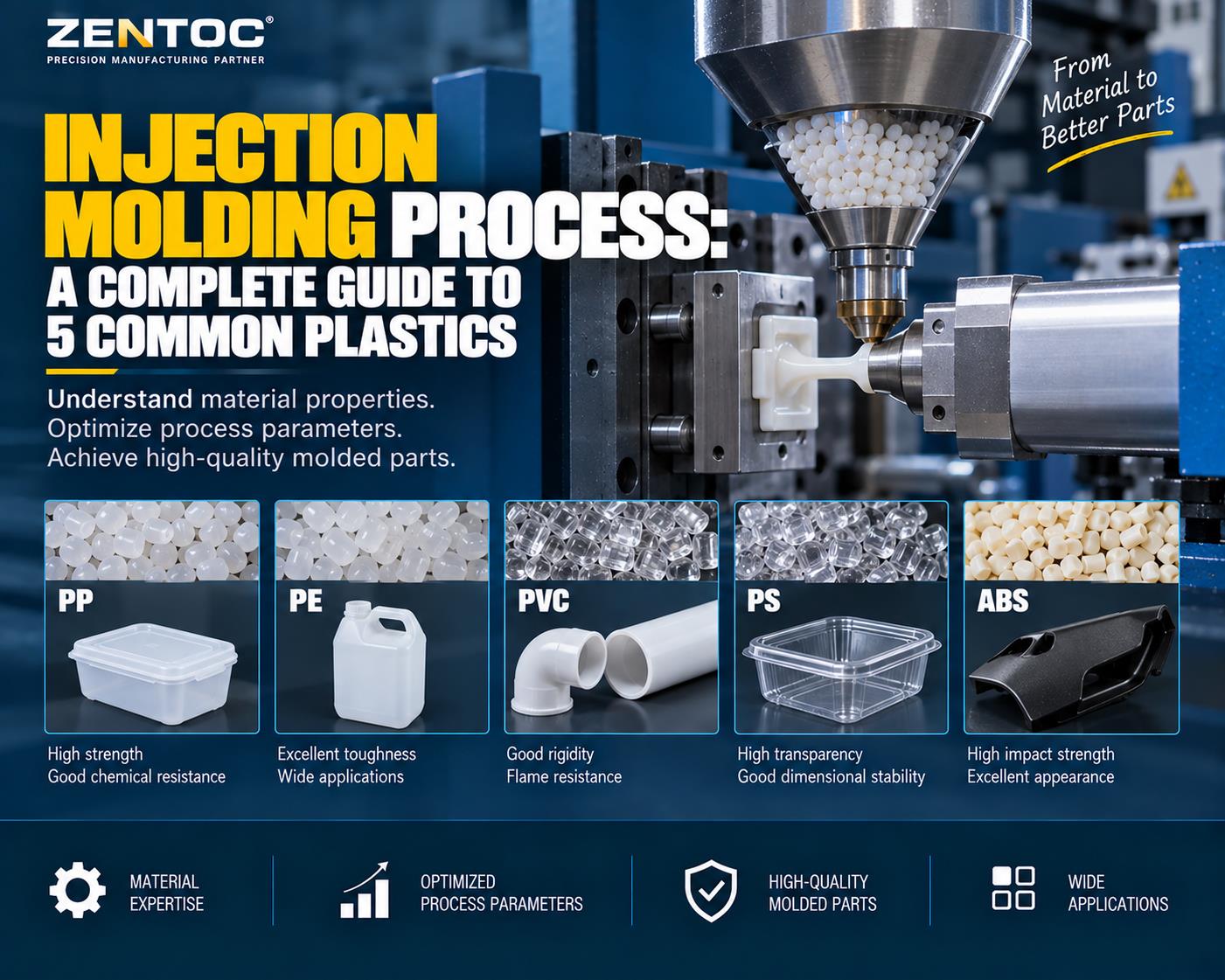
Understanding plastic material properties is fundamental to injection molding. Crystallinity, moisture absorption, melt flow, shrinkage, thermal stability and cooling behavior determine suitable process parameters and influence common molding defects.
This guide compares the injection molding processes for PP, PE, PVC, PS and ABS, including drying, melt temperature, mold temperature, injection pressure, gate design and important processing precautions.
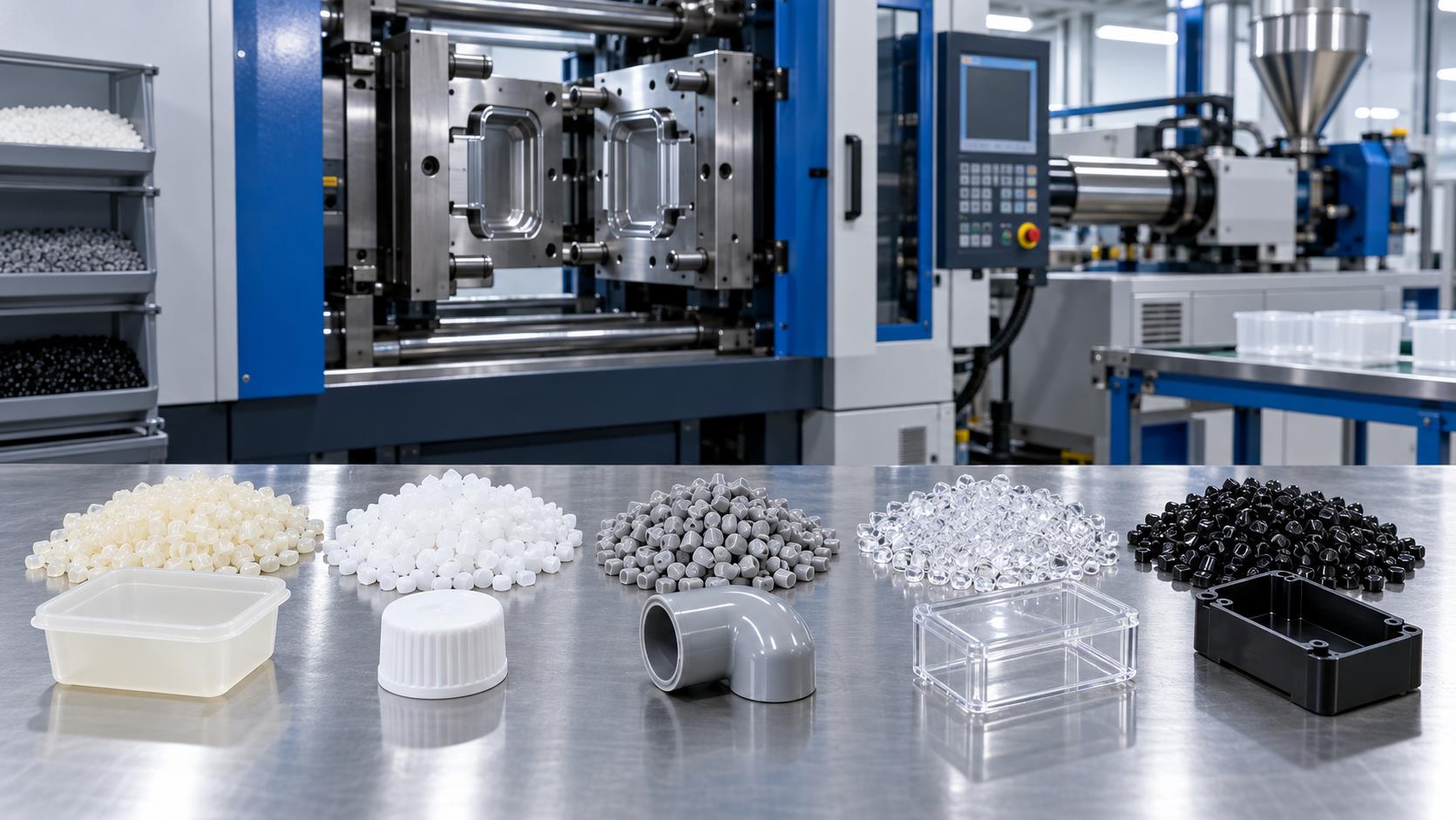
1. PP, PE, PVC, PS and ABS Processing Comparison
| Plastic | Material Type | Drying | Melt or Barrel Temperature | Mold Temperature | Injection Pressure |
|---|---|---|---|---|---|
| PP | Semi-crystalline | Usually unnecessary | Melt zone around 240 degrees C | 50-90 degrees C | 1500-1800 bar |
| PE | Crystalline | Usually unnecessary | LDPE 140-200 degrees C; HDPE about 220 degrees C | LDPE 30-45 degrees C; HDPE 10-20 degrees C higher | 50-100 MPa |
| PVC | Amorphous | Usually unnecessary | 185-205 degrees C | 20-50 degrees C | Up to 1500 bar |
| PS | Amorphous | Usually unnecessary | 180-280 degrees C | 40-50 degrees C | 200-600 bar |
| ABS | Amorphous | Required | 210-280 degrees C; about 245 degrees C suggested | 25-70 degrees C | 500-1000 bar |
These are reference ranges from the source process. Actual settings must be validated for material grade, machine, mold, wall thickness, colorants and quality requirements.
2. Polypropylene (PP) Injection Molding
PP is a semi-transparent, semi-crystalline thermoplastic with excellent repeated-bending resistance, good strength, electrical insulation, low water absorption, low density and relatively high heat-deflection temperature.
2.1 Modifiers and Flow
Glass fiber, mineral filler and thermoplastic rubber are common. Flow varies considerably by grade and is generally between typical ABS and PC.
2.2 Color and Outdoor Use
Pure PP is translucent ivory white. Masterbatch is common for color; UV stabilizers and carbon black are used for outdoor parts.
2.3 Recycled Material
The source recommends keeping recycled PP below about 15% to reduce strength loss, degradation and discoloration.
2.4 Drying and Machine
Special drying is normally unnecessary. A computer-controlled machine with high pressure and multi-stage control is preferred because PP crystallizes strongly.
The reference machine settings include about 3800 t/m2 clamping force and 20-85% shot-size utilization.
3. PP Mold Design and Mold Temperature
| PP Mold Feature | Reference Value or Guidance |
|---|---|
| Mold temperature | 50-90 degrees C; use the higher range for dimensional accuracy |
| Core temperature | At least about 5 degrees C lower than cavity temperature |
| Runner diameter | 4-7 mm |
| Pin gate length | 1-1.5 mm |
| Pin gate diameter | As small as 0.7 mm |
| Edge gate length | As short as practical, around 0.7 mm |
| Edge gate depth | About 50% of wall thickness |
| Edge gate width | About twice wall thickness |
| Vent depth | Approximately 0.025-0.038 mm |
| Vent land | Approximately 1.5 mm |
| Rib thickness | About 50-60% of nominal wall thickness |
Large rounded gates and round runners can help reduce sink marks. The source recommends limiting homopolymer PP thickness to about 3 mm to avoid bubbles and using copolymer PP for thick-wall parts.
4. PP Melt Temperature, Speed and Pressure
4.1 Temperature
PP melts around 160-175 degrees C and decomposes near 350 degrees C. Processing should remain below about 275 degrees C, with a melt-zone target around 240 degrees C.
4.2 Injection Speed
High speed can reduce internal stress and deformation, but some grades and molds may develop bubbles or flow marks. Adjust speed with mold temperature.
4.3 Pressure
Reference injection pressure is 1500-1800 bar, with holding pressure near 80% of injection pressure and transfer at about 95% of stroke.
4.4 Back Pressure and Conditioning
About 5 bar back pressure is referenced, with higher values for powdered pigments. Hot-water conditioning may reduce post-crystallization shrinkage and distortion.
5. Polyethylene (PE) Injection Molding
PE is a crystalline thermoplastic with moisture absorption of about 0.01% or less, so drying is normally unnecessary. Its flexible molecular chains produce low viscosity and excellent flow, allowing thin-wall, long-flow parts at moderate pressure.
5.1 Shrinkage and Warpage
Reference shrinkage is about 1.22% for LDPE and 1.5% for HDPE. Directional shrinkage makes uniform mold cooling critical.
5.2 Crystallization
Higher mold temperature slows cooling and increases crystallinity and strength, but can also increase shrinkage.
5.3 Plasticizing and Cooling
PE has a low melting point but high specific heat. Use adequate heating capacity and sufficient cooling time.
5.4 Gate and Ejection
Direct gates can increase stress and directional warpage. PE parts are soft and generally eject easily; shallow undercuts may sometimes be stripped.
Minimize melt contact with oxygen because PE can oxidize. The source notes good thermal stability and no significant decomposition below roughly 300 degrees C.
6. PE Injection Molding Parameters
| Parameter | LDPE | HDPE |
|---|---|---|
| Barrel temperature | 140-200 degrees C | About 220 degrees C in the source guidance |
| Mold temperature | 30-45 degrees C | Approximately 10-20 degrees C higher than LDPE |
| Injection pressure | Typically 50-100 MPa; lower for simple thick parts and higher for thin-wall or long-flow geometry | |
Use the lower temperature at the rear of the barrel and increase toward the front. Barrel settings depend on density, melt-flow rate, machine and part geometry.
7. Polyvinyl Chloride (PVC) Injection Molding
PVC is an amorphous material used for pipes, wall panels, housings, packaging and medical products. Stabilizers, lubricants, processing aids, pigments and impact modifiers are commonly compounded into PVC.
7.1 Processing Window
PVC has poor flow and a narrow temperature range. Excess temperature or residence time can cause degradation, so low-molecular-weight grades and lubrication are common for injection molding.
7.2 Reference Parameters
Drying is normally unnecessary. Melt temperature is 185-205 degrees C, mold temperature 20-50 degrees C, injection pressure up to 1500 bar and holding pressure up to 1000 bar.
7.3 Injection Speed
The source recommends relatively low speed to limit heat generation and material degradation.
7.4 Gate Design
Use pinpoint or submarine gates for smaller parts and fan gates for thicker sections. Minimum pinpoint or submarine diameter is about 1 mm; fan-gate thickness at least 1 mm.
Typical PVC shrinkage is about 0.2-0.6%. Rigid PVC is among the most commonly processed types.
8. Polystyrene (PS) Injection Molding
PS is a transparent amorphous thermoplastic with excellent geometric stability, optical clarity, electrical insulation, low moisture absorption and typical shrinkage of about 0.4-0.7%.
| PS Parameter | Reference Setting |
|---|---|
| Drying | Normally unnecessary; if required, 80 degrees C for 2-3 hours |
| Melt temperature | 180-280 degrees C |
| Flame-retardant upper limit | About 250 degrees C |
| Mold temperature | 40-50 degrees C |
| Injection pressure | 200-600 bar |
| Injection speed | Relatively high |
| Gate types | Most conventional gate designs are suitable |
PS is used for packaging, household trays, transparent enclosures, light diffusers and insulating films. Some organic solvents can cause swelling or deformation.
9. ABS Injection Molding
ABS combines acrylonitrile for strength and chemical stability, butadiene for toughness, and styrene for processability, appearance and strength. It offers low creep, dimensional stability, high impact strength and flexible grade selection.
9.1 Drying
ABS is hygroscopic. Dry at 80-90 degrees C for at least 2 hours and control moisture below 0.1%.
9.2 Melt Temperature
Use 210-280 degrees C, with about 245 degrees C suggested by the source as a practical processing value.
9.3 Mold Temperature
Use approximately 25-70 degrees C. Low mold temperature can reduce surface gloss.
9.4 Pressure and Speed
Reference pressure is 500-1000 bar with medium-to-high injection speed.
ABS is widely used for automotive trim, appliance parts, consumer products, equipment housings and impact-resistant components.
10. How to Select Injection Molding Parameters
10.1 Match Material Structure
Crystalline PP and PE require careful cooling and shrinkage control. Amorphous PVC, PS and ABS have different thermal and moisture sensitivities.
10.2 Confirm the Material Grade
Fillers, flame retardants, recycled content, molecular weight, melt-flow rate and colorants can shift suitable settings.
10.3 Consider Part and Mold Design
Wall thickness, flow length, ribs, gates, runners, vents and cooling layout affect pressure, speed, temperature and holding time.
10.4 Troubleshoot Systematically
Relate defects to material drying, degradation, flow, cooling, crystallization, shrinkage, pressure and venting instead of changing settings randomly.
Conclusion
PP, PE, PVC, PS and ABS have different crystallinity, moisture absorption, melt behavior, shrinkage, thermal stability and cooling requirements. These differences make material-specific injection molding parameters essential.
Select suitable drying, melt temperature, mold temperature, pressure, speed, holding, cooling and gate design for the exact resin and part. This improves molding stability, reduces defects and supports consistent product quality.
Injection Molding Materials FAQ
Which of these plastics normally requires drying?
ABS requires drying. PP, PE, PVC and PS normally do not, although PS may require drying after poor storage.
Why does PE warp easily?
PE has relatively high and directional shrinkage, and its crystallization is strongly influenced by cooling and mold temperature.
Why is PVC difficult to injection mold?
PVC has poor flow, a narrow processing window and sensitivity to thermal degradation.
How does mold temperature affect ABS appearance?
Lower mold temperature can reduce the surface gloss of molded ABS parts.
Why does PP require careful holding-pressure control?
PP is highly crystalline and can shrink during cooling and post-crystallization, so holding pressure and time strongly influence dimensions and sink marks.
Need Custom Injection-Molded Components?
Zentoc provides mold manufacturing, plastic injection molding and custom production solutions.
Contact Zentoc