Machine safety is one of the most important requirements in manufacturing. CNC machines, rotating components, cutting tools, electrical systems, hot metal, welding equipment and material-handling operations can cause serious injuries when equipment is incorrectly designed, maintained or operated.
This manufacturing safety guide summarizes common mechanical hazards, machine guarding requirements, operator safety rules and practical precautions for CNC machining, turning, milling, drilling, grinding, pressing, forging, casting and welding.
1. Common Mechanical Hazards in Manufacturing
| Hazard source | Examples | Potential injury |
|---|---|---|
| Rotating machine parts | Gears, pulleys, chucks, shafts, lead screws and couplings | Entanglement, crushing, impact and ejected-part injuries |
| Linear or reciprocating motion | Presses, forging hammers, shaper rams, planer tables and lifting equipment | Pinching, crushing, squeezing and impact |
| Cutting and abrasive tools | Lathe tools, milling cutters, drills, grinding wheels and saw blades | Cuts, punctures, burns and severe contact injuries |
| Workpieces and fixtures | Loose rotating stock, heavy parts and inadequate workholding | Thrown-object, crushing and handling injuries |
| Electrical systems | Motors, cabinets, cables, switches and grounding systems | Electric shock, burns and fire |
| Process environment | Heat, light, chemicals, radiation, dust, noise and vibration | Acute injury and occupational exposure |
2. Basic Machine Safety Requirements
Safe Machine Layout
Provide room for loading, observation, chip removal, operation and maintenance. Keep pedestrian and vehicle aisles clear.
Strength and Reliability
Machine components, foundations and fasteners must withstand intended operating loads and be maintained to prevent failure.
Overload and Limit Protection
Use suitable load limiters, travel switches, safety valves, temperature relays, timers or automatic shutdown devices.
Warnings and Interlocks
Warning lights, audible signals and sequential interlocks help prevent operation under abnormal or incorrectly sequenced conditions.
3. Electrical Safety for Machinery
Install power cables correctly and replace damaged insulation or exposed conductors.
Maintain motor insulation and cover terminal connections.
Keep switches and push buttons intact with no accessible live components.
Provide reliable grounding and inspect protective conductors regularly.
Use machine lighting that complies with the applicable electrical standard and design.
Allow only appropriately qualified personnel to inspect or repair electrical equipment.
4. Machine Controls and Foot Switch Safety
Control Handles
Important handles need reliable positioning and locking. Similar controls should be clearly distinguishable.
Handwheels
Where required, handwheels should disengage from powered shafts during automatic operation to prevent unexpected rotation.
Foot Switches
Guard or recess foot controls to prevent dropped objects or accidental contact from starting dangerous motion.
5. Common Machine Guarding Devices
| Guard type | Function | Typical application |
|---|---|---|
| Fixed guard | Permanent physical separation from danger | Belts, gears, couplings and transmission components |
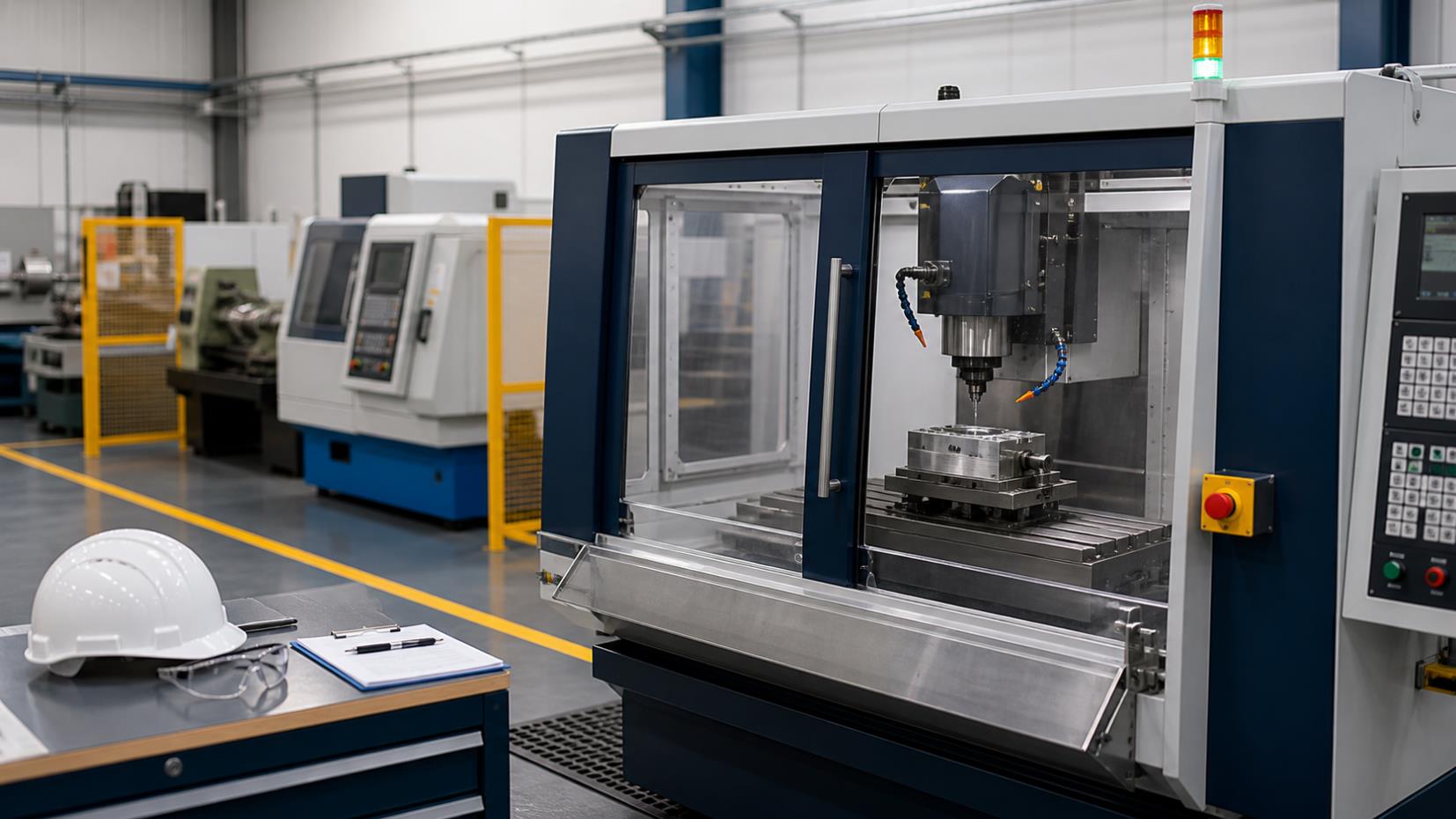
| Interlocked guard | Prevents normal operation when the guard is unsafe | CNC doors, access panels and enclosed cells |
| Automatic protective device | Detects or prevents exposure during operation | Presses, feeding systems and automated equipment |
| Screen or shield | Contains chips, abrasive particles and coolant | Milling, turning, drilling and grinding |
| Barrier or safety fence | Restricts personnel access to a hazardous zone | Robots, transfer systems and hot-working areas |
6. General Machine Operator Safety Rules
Before Operation
Complete the required inspection
Check guards and safety devices
Secure tools, fixtures and workpieces
Confirm normal unloaded operation where required
Do not use defective equipment
During Operation
Keep loose clothing, jewelry and hair controlled
Avoid gloves near exposed rotating machinery
Never reach into hazardous motion
Do not remove chips by hand
Remain at the workstation when required
Before Intervention
Stop hazardous machine motion
Use the required isolation procedure
Measure, adjust, lubricate or clean only when safe
Use brushes, hooks and approved handling tools
After Operation
Turn off equipment correctly
Place tools and workpieces safely
Remove waste with suitable tools
Clean and organize the machine area
7. Machine Shop Safety and Workshop Layout
Metal machining workshops need sufficient space, glare-free lighting, safe chip removal, material-transport routes and clearly marked aisles. Workpieces, fixtures and tools should be stored neatly to prevent trips, collisions and falling-object hazards.
Machine Guards
Isolate exposed rotating and moving components.
Protective Shields
Contain grinding debris, metal chips and coolant spray.
Safety Devices
Use overload protection, travel limits, interlocks, braking systems and emergency controls as required.
8. Machine-Specific Safety Rules
| Equipment | Essential safety practices |
|---|---|
| Lathe | Stop before chuck work or manual measurement; secure long stock; balance irregular parts; minimize tool overhang; remove string chips with a hook; keep hands and clothing away from rotation. |
| Milling machine | Clamp securely; feed into the cut gradually; stop before hazardous adjustment; remove chips with a brush; stop the spindle before clearing chips from the cutter. |
| Shaper and planer | Set and lock the stroke; keep clear of ram travel; avoid a deep first cut; guard reciprocating zones and collect chips safely. |
| Grinding machine | Verify the workholding system; maintain starting clearance; begin with light infeed; use the required wheel guard; stop before adjustment, measurement or cleaning. |
| Drill press | Secure hair; do not wear entanglement-prone gloves; lock the table and radial arm; never remove chips by hand; reduce force near breakthrough. |
| Press and stamping machine | Inspect guards, clutch and brake; guard foot controls; use feeding tools; keep hands out of die space; stop and use the designated tool for stuck parts. |
| Bench and fitting work | Inspect hand tools, tension saw blades, install chip screens and control hammer swing areas. Restore every guard and signal after maintenance. |
9. Hot Metalworking, Steelmaking, Casting and Forging Safety
Hot Metalworking
Keep charge material and tools dry, prevent water from entering pits, avoid overfilled ladles, install heat shields and maintain clear non-slip aisles.
Steelmaking
Never introduce wet or prohibited material, pour into wet containers or ignore furnace, ladle, cooling-water or water-ingress abnormalities.
Casting
Keep pouring areas dry, preheat applicable tools, secure mold boxes, provide venting, control riser exposure and restrict access.
Forging
Use tongs, keep hands outside impact zones, coordinate hammering, control separated material and secure equipment before inspection.
10. Welding Hazards and Safety
Welding can combine fire, explosion, toxic fumes, arc radiation, dust, electrical hazards, heat, noise, work-at-height and confined-space risks. Controls may include ventilation, hot-work permits, fire prevention, electrical protection, screens, respiratory protection, fall protection and atmospheric monitoring.
11. Essential Machine Safety Principles
Inspect machinery before operation.
Keep machine guards and safety devices installed and functional.
Secure workpieces, fixtures and cutting tools correctly.
Keep hands, clothing and hair away from rotating and reciprocating parts.
Never remove chips by hand from operating machinery.
Stop and isolate hazardous motion before adjustment, measurement, cleaning or maintenance.
Wear the PPE selected for the specific risk assessment.
Do not operate defective equipment.
Maintain clean, illuminated and unobstructed work areas.
Follow manufacturer instructions, workplace procedures and applicable safety regulations.
Machine Safety FAQ
What are the main mechanical hazards in a machine shop?
Common hazards include rotating and reciprocating parts, cutting tools, ejected workpieces, sharp chips, crushing zones, electrical systems, noise, vibration and hazardous process emissions.
What is the purpose of machine guarding?
Machine guarding separates people from hazardous motion, prevents access to danger zones and helps contain chips, fragments and coolant.
Can gloves be worn around rotating machinery?
Gloves can increase entanglement risk around exposed rotating parts. Follow the machine-specific risk assessment and workplace procedure; do not wear gloves where they can be caught.
When should a machine be stopped before intervention?
Stop hazardous motion before manual measurement, adjustment, lubrication, cleaning or chip removal. Maintenance may also require full energy isolation under the approved procedure.
Who may repair machine electrical equipment?
Electrical inspection and repair should be completed only by appropriately qualified and authorized personnel under applicable rules.
Precision Manufacturing with Safety and Process Control
Zentoc supports CNC machining, mold manufacturing and custom production with a focus on controlled processes, reliable quality and responsible manufacturing practices.
Contact Zentoc