Injection mold quality depends on far more than one machining operation. Mold design, steel selection, precision machining, fitting, polishing, assembly, cooling, testing and maintenance all affect mold accuracy, service life, cycle time and molded-part quality.
This guide examines 10 key factors across the complete injection mold manufacturing lifecycle and explains how manufacturers can improve production stability while controlling cost.
1. Mold Steel Selection
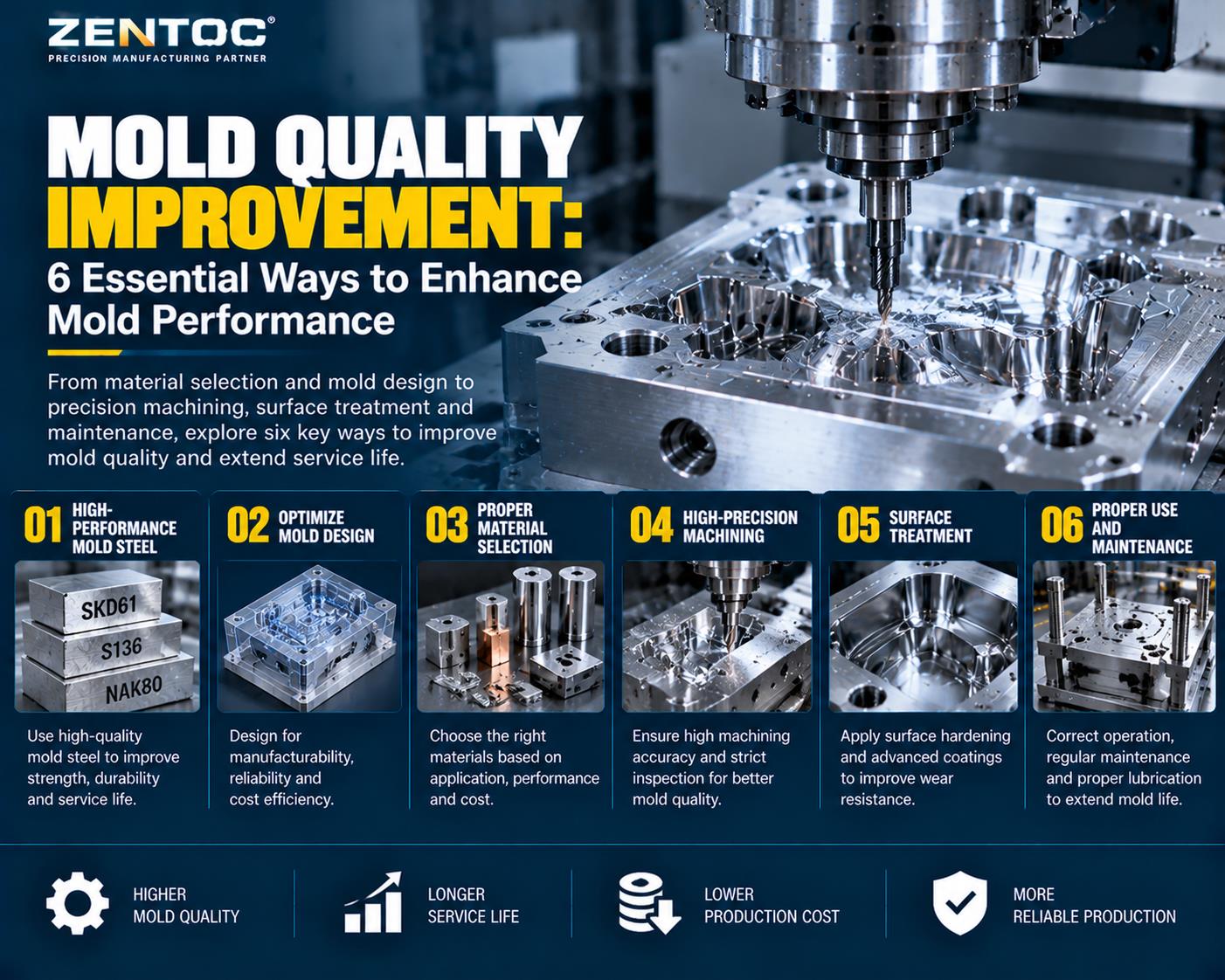
Mold steel establishes the foundation for durability, polishing performance, corrosion resistance and production life. The best choice meets the actual resin, surface and cycle requirements without unnecessary cost.
1.1 Plastic Material Requirements
Some plastics require excellent polishability for high-gloss parts, while corrosive materials or environments demand greater corrosion resistance.
1.2 Mold Life and Cost
A higher-priced steel is not automatically better. Match performance and heat-treatment capability to the required service life.
1.3 Surface Treatment
Nitriding can improve surface hardness and wear resistance. Electroplating may improve brightness, release or corrosion resistance.
1.4 Material Verification
Confirm steel grade, hardness condition and certification before machining critical plates and inserts.
| Mold Steel | Approximate Mold-Life Reference | Selection Note |
|---|---|---|
| P20 | About 300,000 cycles | Common option for moderate production requirements |
| 2738 | About 500,000 cycles | Used when greater service life and uniform performance are required |
| H13 / 2344 | Generally 800,000-1,000,000+ cycles | Suitable for demanding wear and high-volume requirements after proper treatment |
These figures are approximate source references. Actual life depends on steel quality, heat treatment, part design, resin, processing and maintenance.
2. Injection Mold Structure Design
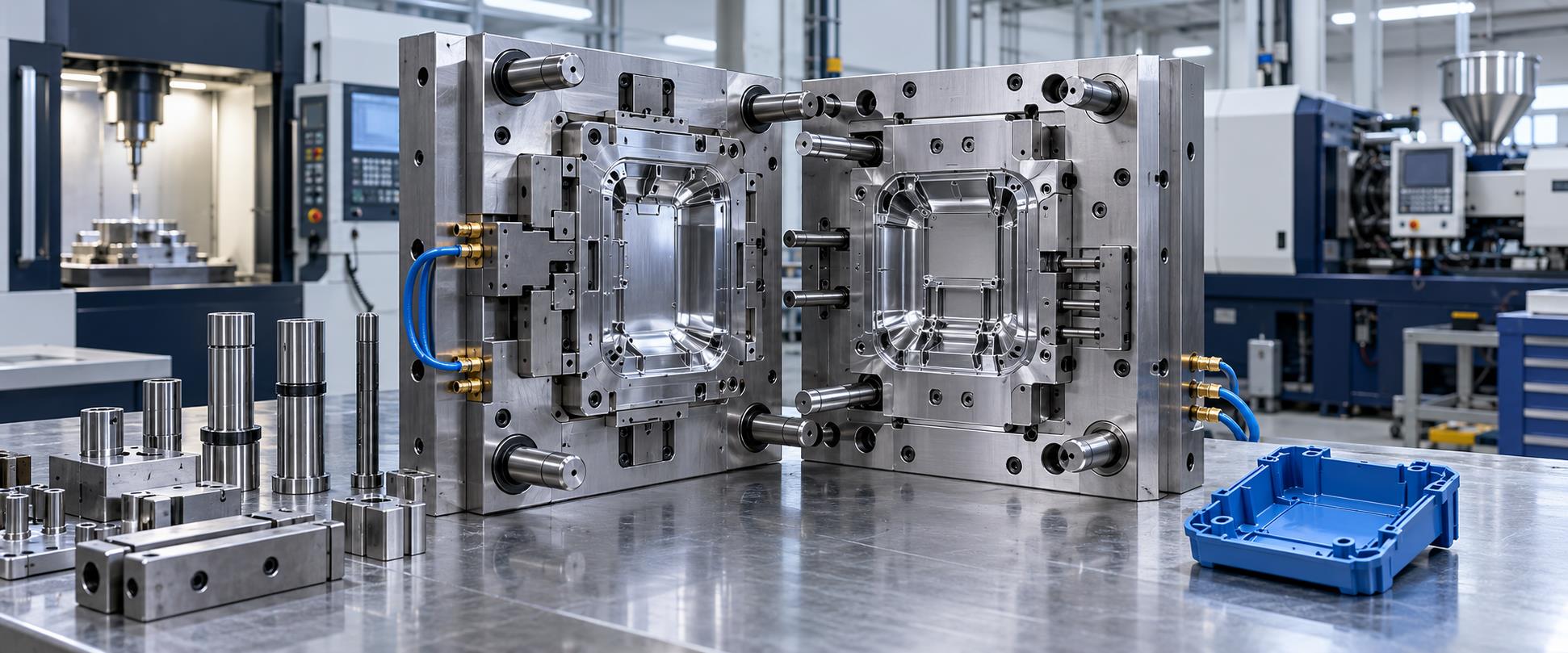
A reliable injection mold design considers product geometry together with plastic shrinkage, molding temperature, elastic deformation, cooling, ejection and mold motion.
2.1 Material Behavior
Account for resin flow, shrinkage, temperature sensitivity and deformation during filling, cooling and ejection.
2.2 Moving Mechanisms
Sliders, lifters, inserts and ejectors require sufficient guidance, support, clearance and wear resistance.
2.3 Opening and Closing
Design a stable sequence that avoids interference and protects molded parts and mold components.
2.4 Manufacturing Efficiency
A practical structure improves serviceability, shortens production cycles and reduces long-term cost.
3. Precision Mold Machining
The right equipment, datum strategy and machining sequence improve accuracy while shortening lead time. Poor machining can interfere with movement, require welding and repairs, or create cracking and failure risks.
3.1 Process Planning
Coordinate roughing, heat treatment, semi-finishing, grinding, EDM and finishing around stable references.
3.2 Accuracy Control
Control dimensions, geometry, insert fit, parting surfaces and positional relationships throughout production.
3.3 Repair Prevention
Accurate machining reduces welding that may introduce local stress, hardness variation or dimensional risk.
4. Mold Standard Components
A mold is a complete mechanical system and can be limited by its weakest component. Guide pillars, bushings, springs, fasteners and ejectors influence movement and reliability.
4.1 Wear Resistance
Frequently moving components need suitable hardness and surface quality for long-term service.
4.2 Dimensional Accuracy
Accurate standard parts support alignment, repeatability and reliable assembly.
4.3 Deformation Resistance
Components must carry operating loads without permanent bending or loss of precision.
4.4 Cost vs. Performance
Select parts for required mold life and production conditions instead of initial price alone.
5. Mold Fitting and Spotting
Mold fitting and spotting ensure that parting surfaces close correctly, moving components operate together and unacceptable mismatch or flash is avoided.
5.1 Parting-Surface Contact
Verify even, controlled contact without local high points that can damage the mold or create flash.
5.2 Complex Mechanisms
Complex molds may require coordinated fitting of irregular parting lines, sliders and lifters.
5.3 Problem Detection
Spotting can reveal machining, assembly and alignment problems before production trials.
5.4 Production Stability
Correct fitting improves accuracy, movement, parting-line quality and repeatable closing.
6. Mold Polishing and Surface Texture
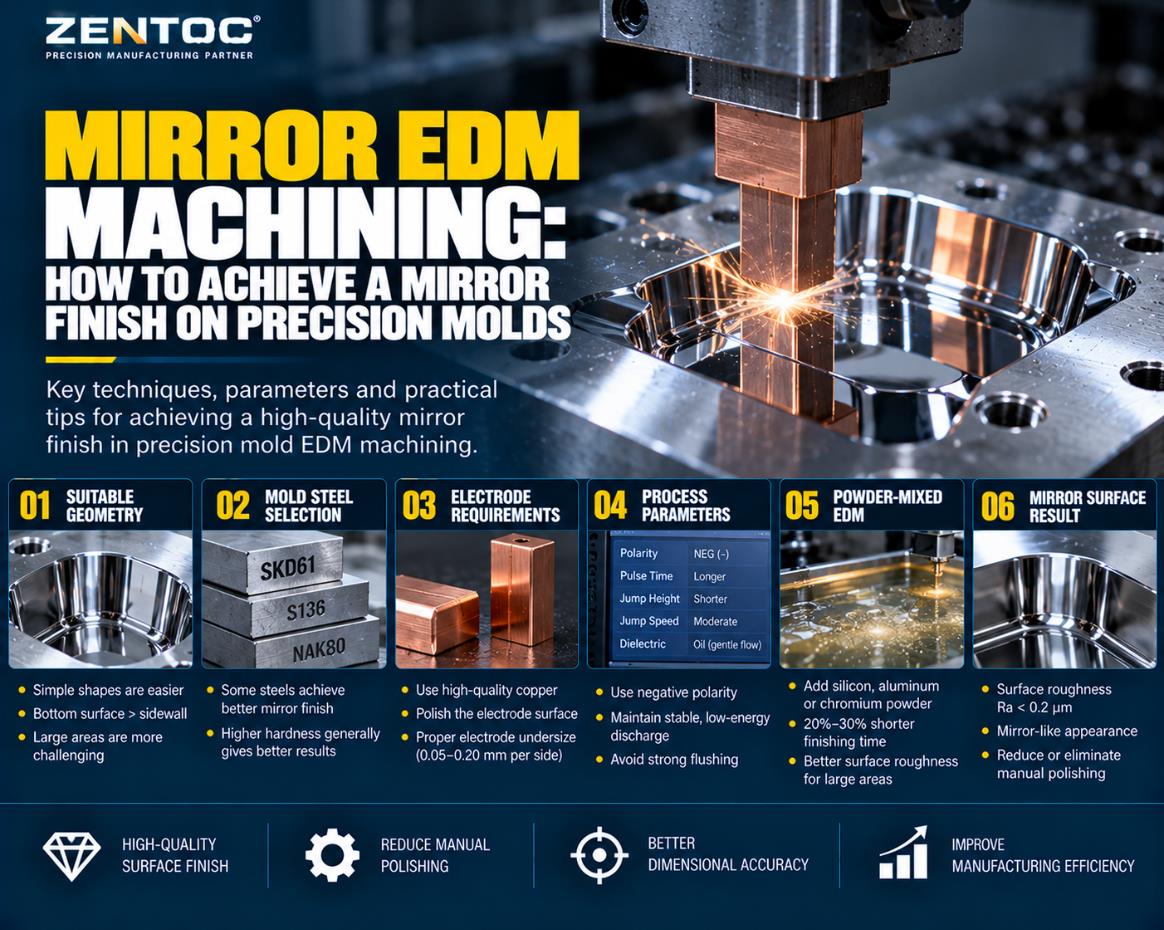
Polishing and texture affect molded-part appearance, release behavior and ejection stability. Insufficient polishing can cause resistance, whitening near ejectors, stress marks or cracking.
6.1 Surface Appearance
The cavity finish is reproduced on the plastic part, making polishing critical for visible products.
6.2 Demolding Performance
Proper polishing, draft and texture direction reduce friction and support stable release.
6.3 Texture Consistency
Textured surfaces require controlled depth, uniformity and repair transitions.
6.4 Edge Protection
Polishing must preserve critical geometry, shutoffs, radii and parting edges.
7. Injection Mold Assembly
An injection mold is assembled like a precision machine. Every insert, mechanism and fastener must be clean, correctly oriented and installed to specification.
7.1 Cleanliness
Remove chips from cooling channels, screw holes, mating surfaces and internal passages.
7.2 Component Position
Verify orientation, seating, preload, clearances and travel before final tightening.
7.3 Movement Checks
Test ejectors, slides, lifters, return systems and safety interlocks before molding trials.
7.4 Assembly Records
Document components, settings and inspection results for maintenance and future repair.
8. Hot Runner vs. Cold Runner Systems
| System | Quality Priorities | Potential Risk |
|---|---|---|
| Hot runner | Reliable heaters, temperature control, thermal balance, sealing and support | Component or control failure can interrupt production and affect filling |
| Cold runner | Balanced filling, gate size, runner configuration and injection pressure | Unbalanced flow may cause dimensional or appearance differences |
Either system must deliver stable and balanced melt flow. The choice depends on resin, part quality, cavity count, volume and economic requirements.
9. Mold Cooling System Design
A well-designed mold cooling system controls temperature uniformly, shortens cycle time and improves part consistency. Reducing cooling time without sufficient heat removal can overheat and deform the mold.
9.1 Channel Layout
Place circuits near heat sources while respecting cavity strength and component clearances.
9.2 Diameter and Density
Use suitable channel size and spacing for effective flow and heat transfer.
9.3 Circuit Connections
Avoid flow restrictions, trapped air and unnecessarily long series circuits.
9.4 Temperature Uniformity
Balance core, cavity, sliders and hot areas to reduce warpage and cycle variation.
10. Injection Mold Maintenance
Injection mold maintenance protects accuracy and movement during production and storage. After each run, inspect the mold, remove contamination, dry water circuits and apply corrosion protection.
10.1 Production Inspection
Check wear, lubrication, looseness, leakage, abnormal marks and movement before failure occurs.
10.2 Rust Prevention
Protect molding surfaces, core and cavity areas, moving parts and exposed steel.
10.3 Cooling-System Care
Drain and dry circuits where necessary and prevent scale, corrosion and blockage.
10.4 Storage Control
Store molds clean and dry with records of their condition and required future service.
11. How the Complete Lifecycle Determines Mold Quality
Steel provides durability; structure governs function; machining and fitting establish accuracy; polishing influences appearance and release; assembly, runners and cooling determine production stability; maintenance preserves performance.
Conclusion
Consistent injection mold quality requires control from material selection and design through machining, assembly, molding and maintenance. Optimizing steel, structure, machining, components, fitting, polishing, assembly, runners, cooling and maintenance creates a more reliable production system.
A lifecycle approach helps manufacturers achieve stable molding, longer mold life and lower total manufacturing cost.
Injection Mold Quality FAQ
What is the most important factor affecting injection mold quality?
No single factor determines quality. Steel, design, machining, fitting, cooling, assembly and maintenance must work together.
Does more expensive mold steel always produce a better mold?
No. Steel should be selected for the resin, surface requirement, expected cycles, heat treatment and operating conditions.
Why is mold cooling design so important?
Cooling controls cycle time, temperature uniformity, dimensional consistency, warpage and long-term stability.
How does polishing affect injection molding?
Polishing affects appearance and release. Poor finishing can increase demolding resistance and cause whitening, stress marks or cracking.
How can injection mold service life be extended?
Use suitable materials and components, control machining and assembly, maintain balanced cooling and runners, and perform regular cleaning, lubrication and rust prevention.
Need a Reliable Custom Injection Mold?
Zentoc provides injection mold design, precision mold manufacturing, plastic injection molding and customized production solutions.
Contact Zentoc