Robots may look complex, but their basic working principles are straightforward. A robot combines a mechanical structure, actuators, sensors, a power system and computer control to perform physical tasks.
This guide explains how robots work, including industrial robotic arms, end effectors, mobile robots, autonomous navigation, DIY robotics and the role of artificial intelligence in robotics.
1. Basic Components of a Robot
A programmable robot resembles a simplified biological system: a structure supports it, actuators create movement, sensors collect information, a power source supplies energy and a computer coordinates the complete machine.
1.1 Mechanical Structure
Frames, links, wheels, shafts and joints form the robot's physical body. Components are commonly made from metal, engineering plastic or composites.
1.2 Robot Actuators
Electric motors, solenoids, hydraulic cylinders and pneumatic cylinders convert energy into controlled movement.
1.3 Power Supply
Robots may use batteries, external electricity, hydraulic pumps or compressed-air systems according to size, mobility and force requirements.
1.4 Control Circuits
Electrical circuits switch motor power and control valves that direct hydraulic fluid or compressed air.
1.5 Computer Controller
The controller sends commands in the correct sequence and makes the robot reprogrammable for different tasks.
1.6 Sensors and Feedback
Cameras, force sensors, microphones, encoders and distance sensors provide information about the robot and its environment.
2. How Robot Motion Feedback Works
Motion feedback allows a controller to compare commanded movement with actual movement. Optical encoders are widely used for this purpose.
2.1 Encoder Wheel
A slotted or patterned wheel rotates with the motor shaft or robot joint.
2.2 Light Detection
A light source and photosensor generate pulses as the pattern alternately passes and blocks light.
2.3 Position Calculation
The controller counts and interprets pulses to calculate rotation, direction and speed.
3. How Industrial Robotic Arms Work
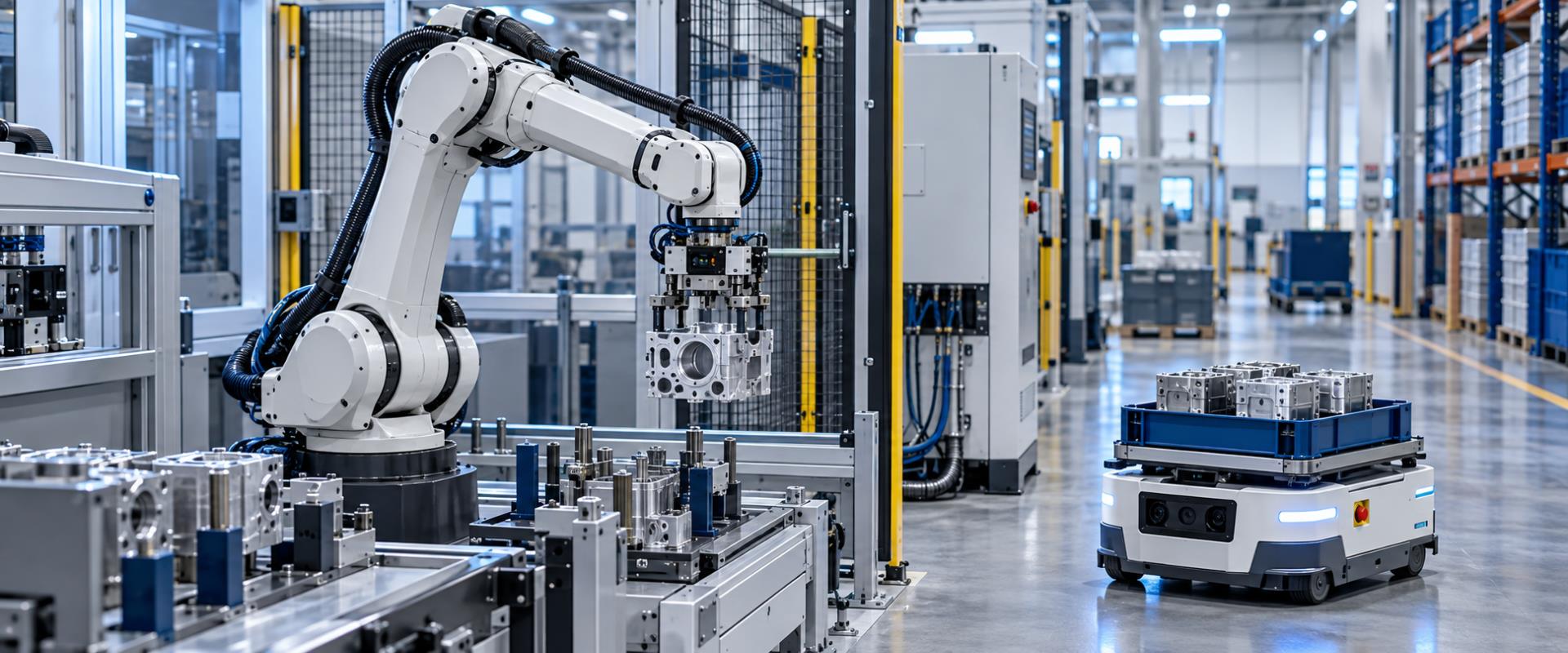
An industrial robotic arm uses rigid links connected by powered joints. A common six-axis robot can position and orient a tool through six independent degrees of freedom.
3.1 Six Degrees of Freedom
Base, shoulder, elbow and wrist joints give the arm a large workspace and flexible tool orientation.
3.2 Joint Drives
Electric servo or stepper motors are common, while hydraulic or pneumatic drives may suit specialized force and environment requirements.
3.3 End Effectors
Grippers, welding torches, drills, spray equipment and custom tools allow one arm platform to perform different operations.
3.4 Force Control
Pressure or force sensors help a gripper hold components without dropping or damaging them.
3.5 Robot Programming
A programmer can use a teach pendant to guide the robot through a motion sequence that is stored and repeated.
3.6 Manufacturing Applications
Robots handle assembly, drilling, fastening, welding, painting, packaging and precise electronics production.
4. How Mobile Robots Move
| Locomotion Type | Main Advantage | Main Challenge | Typical Use |
|---|---|---|---|
| Wheels | Efficient and mechanically simple on flat surfaces | Limited on steps and severe terrain | Factories, warehouses and service robots |
| Tracks | Good traction and load distribution | Turning friction and less efficiency | Inspection and uneven terrain |
| Legs | Can adapt to obstacles and irregular ground | Complex balance and coordinated control | Research, exploration and difficult terrain |
4.1 Leg Actuation
Hydraulic, pneumatic or electric actuators move linked sections in a muscle-like way.
4.2 Balance and Stability
Gyroscopes and inertial sensors provide orientation feedback so the controller can make corrective movements.
4.3 Biological Inspiration
Researchers study humans, animals and insects to develop stable walking patterns and adaptable mechanisms.
4.4 Terrain Selection
The best mobility system depends on surface conditions, payload, speed, energy and obstacle requirements.
5. Remote-Controlled and Autonomous Robots
Mobile robots range from directly controlled machines to systems that independently sense, navigate and select actions.
5.1 Remote-Controlled Robots
Operators send commands through wired, radio or infrared communication. These machines are valuable in hazardous or inaccessible environments.
5.2 Semi-Autonomous Robots
A person may specify the destination while onboard software plans the route and avoids obstacles.
5.3 Autonomous Robots
The robot uses sensor information and programmed rules to perform actions without continuous human control.
5.4 Obstacle Detection
Contact switches, infrared sensors and ultrasonic sensors detect objects and estimate distance.
5.5 Robot Vision
Single or stereo cameras and computer vision identify objects, estimate depth and understand the scene.
5.6 Mapping and Navigation
Robots may follow boundary wires, use a known building map or create new maps from sensor data.
A simple obstacle-avoidance robot demonstrates the sensor-control-actuator relationship: move forward, detect an obstacle, reverse, turn and continue.
6. DIY Robotics and Home-Built Robots
Robot kits, electronic modules, recycled hardware and open development platforms allow hobbyists to build walking robots, household assistants and competition machines.
6.1 Programmable vs. Remote Control
A purely remote-controlled machine may not meet the stricter definition of a programmable robot, while onboard control enables stored and autonomous behavior.
6.2 Robot Soccer
Cameras identify the ball, goals, teammates and opponents while a computer coordinates multiple robots during play.
6.3 Modular Hardware
Motors, wheels, sensors, cameras, microphones and structural parts can be combined for new tasks.
6.4 Learning Platform
DIY robots provide a practical way to study mechanics, electronics, programming and feedback control together.
7. Robot Adaptability and Development Platforms
Traditional robots are often designed for one specialized task. Reusable hardware and software platforms make it easier to adapt robots for new applications.
7.1 Reusable Software
Object tracking, voice recognition and obstacle avoidance can be integrated instead of developed from the beginning.
7.2 Standard Hardware
Infrared sensors, motors, microphones, cameras, structural components and wheels create a modular foundation.
7.3 Application Flexibility
Developers can reconfigure platforms for cleaning, material handling, inspection, pet care and educational projects.
8. Artificial Intelligence in Robotics
Robotics and artificial intelligence overlap when robots use perception, reasoning, learning and decision-making to respond to changing conditions.
8.1 Information Collection
The robot gathers information through sensors or receives structured input from people and other systems.
8.2 Data Interpretation
Software compares new information with models or stored data to identify objects, events and conditions.
8.3 Action Selection
The system evaluates possible actions and selects the one most likely to achieve its objective.
8.4 Robot Learning
A learning robot records whether an action succeeded and can use that experience in similar situations.
8.5 Human-Robot Interaction
Speech, gesture, body-language and tone recognition support more natural communication.
8.6 Distributed Control
Lower-level controllers can manage routine behaviors while higher-level systems plan complex tasks.
9. Challenges and Future of Robotics
Mechanical design can be measured directly, but intelligence, learning and perception remain more difficult to model. Robotics research therefore combines practical engineering with experiments that test theories of natural and artificial intelligence.
9.1 Perception
Robots must extract reliable meaning from noisy camera, audio, force and distance data.
9.2 Safe Decision-Making
Autonomous actions must remain predictable and safe around people, equipment and changing environments.
9.3 Generalization
A robot that succeeds in one controlled task may struggle when objects, lighting or surroundings change.
9.4 Future Applications
Potential growth areas include manufacturing, household assistance, healthcare, communication, exploration and personal services.
10. Robot System Comparison
| Robot Type | Movement | Control | Common Application |
|---|---|---|---|
| Industrial robotic arm | Multi-axis joints in a fixed workspace | Programmed trajectories with feedback | Assembly, welding, machining and handling |
| Autonomous mobile robot | Wheels or tracks across a facility | Mapping, navigation and obstacle avoidance | Material transport and logistics |
| Legged robot | Coordinated powered legs | Balance, terrain sensing and gait control | Inspection, research and difficult terrain |
| Remote-controlled robot | Application-dependent | Human operator through a communication link | Hazardous and inaccessible environments |
| AI-enabled robot | Arm, mobile or combined platform | Perception, decision-making and learning | Adaptive manufacturing and service tasks |
Conclusion
The working principles of robots are based on integrating mechanical structures, actuators, power supplies, sensors and computer control. Industrial robots repeat manufacturing tasks accurately, while mobile and autonomous robots add locomotion, navigation and environmental awareness.
DIY platforms make robotics more accessible, and AI introduces learning, perception and decision-making. Understanding these systems provides a foundation for industrial automation, intelligent manufacturing and future robotics development.
How Robots Work FAQ
What are the five basic components of a robot?
A typical robot has a mechanical structure, actuators, sensors, a power supply and a computer controller.
What is a robot end effector?
It is the tool attached to the end of a robotic arm, such as a gripper, welding torch, drill or spray head.
What does six degrees of freedom mean?
It means a robot can use six independent joint movements to position and orient its end effector.
How does an autonomous robot avoid obstacles?
It uses contact, infrared, ultrasonic or vision sensors, then follows programmed or learned rules to change its path.
Does every robot use artificial intelligence?
No. Many industrial robots execute fixed programs with feedback control. AI is added when perception, learning or adaptive decision-making is required.
Need Precision Components for Robotics and Automation?
Zentoc provides CNC machining, mold manufacturing and customized precision components for automation equipment.
Contact Zentoc