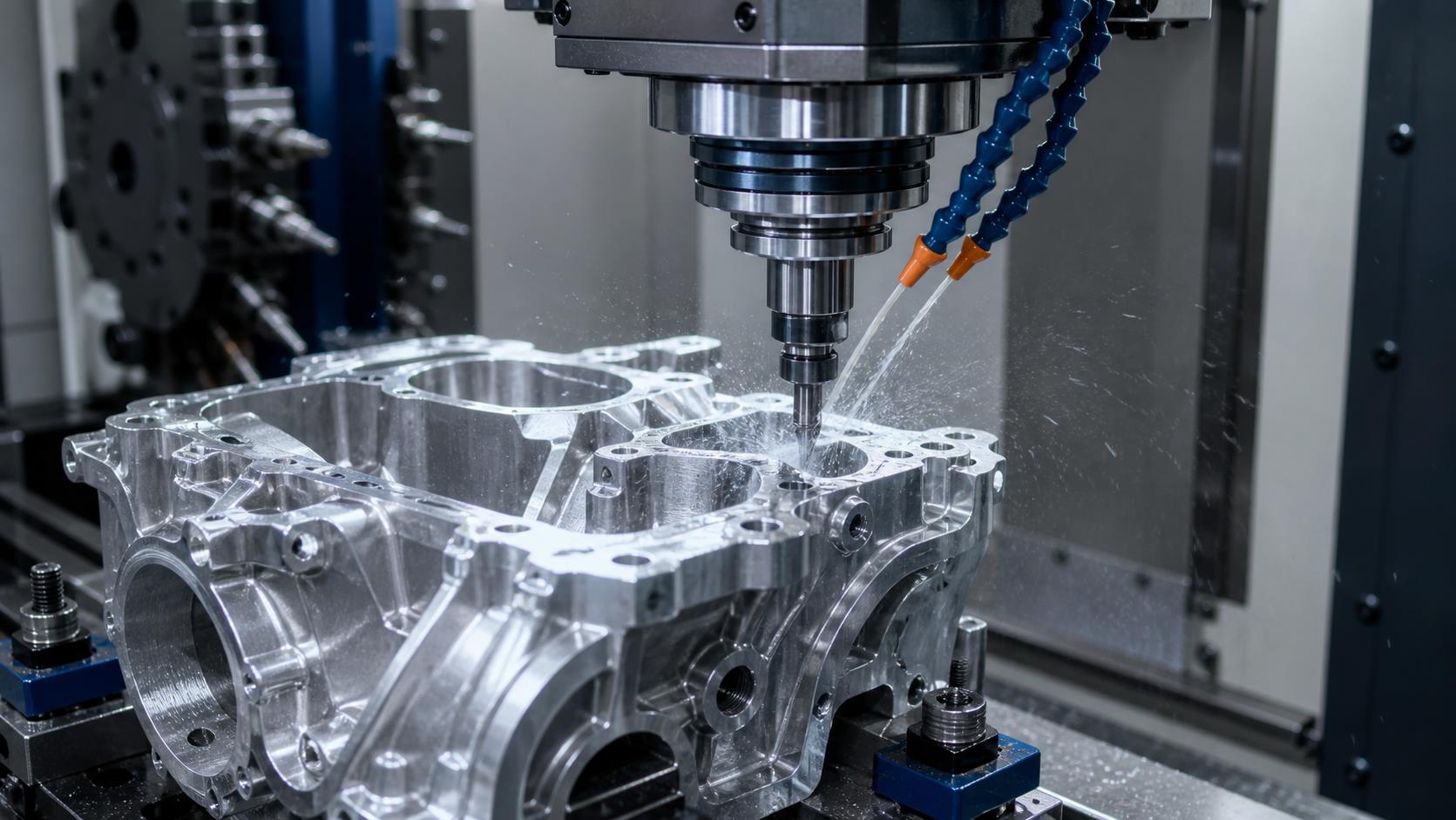
High-Speed Machining, commonly called HSM, combines suitable cutting speeds with relatively high surface feed rates to manufacture qualified parts in the shortest practical cycle time. Aluminum engine blocks and cylinder heads are typical applications where high material removal rates can directly improve production efficiency.
HSM is a complete manufacturing system, not simply a higher spindle-speed setting. Machine tools, cutting tools, holders, fixtures, cutting parameters, coolant, process planning and tool management must work together. A high-performance CNC machine cannot reach its expected productivity when tooling and production support are not properly matched.
1. High-Speed Machining Is an Integrated System
Machine Capability
Spindle speed, power, torque, acceleration, control response, rigidity and thermal stability define the practical machining window.
Process Stability
Fixtures, coolant, tool paths and cutting parameters must control vibration, heat, chip evacuation and dimensional variation.
Tooling System
The cutting edge, holder, spindle interface, presetting and tool-life strategy must operate as one reliable system.
2. Cutting Tool Selection for High-Speed Machining
The first step is to understand the capabilities and limitations of the machine and production process. An expensive tool cannot compensate for insufficient spindle power, poor rigidity, limited feed acceleration or unstable workholding.
Match the Machine
Confirm spindle interface and speed range
Check available power and torque
Review machine dynamics and runout
Verify coolant and chip-removal capability
Match the Operation
Workpiece material and hardness
Roughing or finishing requirement
Feature geometry and tool reach
Required tolerance and surface finish
3. Cutting Tool Materials for HSM
| Tool material | Main strength | Typical consideration |
|---|---|---|
| High-performance HSS | Good toughness and complex tool geometry | High-cobalt and high-vanadium grades may provide about 1.5 to 3 times conventional HSS tool life under suitable conditions. |
| Powder metallurgy HSS | Improved uniformity, strength and toughness | May provide about 20 to 30 percent higher strength and 1.5 to 2 times greater toughness than conventional HSS. |
| Carbide | High hot hardness and broad application range | Grade, geometry and coating must match material, speed and coolant strategy. |
| CBN | Excellent hot hardness and wear resistance | Suitable for selected hardened steels and cast irons. |
| PCD | Very high wear resistance in nonferrous materials | Widely used for aluminum and abrasive composites; normally unsuitable for ferrous cutting at high temperature. |
| Ceramic | Supports very high cutting speed | Requires stable setup and suitable continuous or controlled interrupted cuts. |
4. Tool Holders and Cutting Tool Structure
At high rotational speed, centrifugal force, balance, interface stiffness and runout directly influence accuracy, surface finish and tool life. Holder selection is therefore as important as cutting-edge selection.
High-Performance Holders
HSK systems for high-speed spindle interfaces
Shrink-fit holders for slim geometry and rigidity
Hydraulic holders for damping and repeatable clamping
Balanced assemblies for the intended operating speed
Combination Tools
Drilling and boring tools
Drilling and reaming tools
Combined drilling and threading tools
Custom tools for powertrain production lines
Combination and multifunction tools reduce tool changes and non-cutting time. Their value is especially high in automotive and other high-volume lines where the cycle time of one operation affects the complete system.
5. Evaluate the True Cost of Cutting Tools
Purchase price alone does not reveal whether a tool is economical. The more useful measurement is often tooling cost per qualified component together with the effect on machine utilization.
| Cost factor | Why it matters |
|---|---|
| Cycle time | A faster stable process can release machine capacity and reduce cost per part. |
| Tool life | Longer predictable life reduces stops, scrap risk and tool inventory. |
| Change time | Frequent changes reduce spindle utilization even when each change is short. |
| Regrinding | Include the number of possible cycles, transport, inspection and reconditioning cost. |
| Quality loss | Premature failure can cause scrap, rework and damage to the workpiece or fixture. |
| Support | Application engineering and rapid problem solving can reduce expensive downtime. |
6. Match Tools to the Process and Supplier
Process Integration
Where practical, one tool can perform multiple operations to reduce inventory, tool changes and non-cutting time. Difficult operations may require special-purpose or intelligent tools.
Cutting Validation
Geometry, substrate and coating should be proven through actual cutting tests because fixtures, coolant, machine dynamics and workpiece variation affect results.
Application Engineering
A capable supplier should help optimize cutting data, troubleshoot wear and provide process recommendations based on production evidence.
Technical Partnership
Fast support, solution design and reliable supply transform the relationship from a simple purchase into a manufacturing partnership.
7. Cutting Tool Management for HSM
High cutting speed does not guarantee higher line output. A systematic management process must control tool availability, presetting, inspection, life, replacement and technical response.
Set Realistic Tool Life
Establish life from actual production data and replace tools before wear creates unacceptable quality or failure risk.
Minimize Change Time
Plan replacement across multi-tool machines so qualified tools are ready and machine downtime is minimized.
Improve Presetting
Accurate offline measurement and identification improve first-pass setup success and prevent incorrect tool loading.
8. Identify Production-Line Bottlenecks
Improving one operation may produce no additional finished parts if another machine becomes the constraint. Monitor cycle time, downtime, tool changes and quality losses across the entire line rather than evaluating machines in isolation.
Prevent Abnormal Consumption
Track blank quality, machine stability, coolant condition, tool quality, coating performance and batch consistency to identify premature wear.
Provide Rapid Support
When abnormal wear or failure occurs, the team needs traceable data and prompt technical analysis to minimize production loss.
9. Establish a Cutting Tool Maintenance Program
Complex tools should be maintained systematically, just like production equipment. A preventive program protects accuracy and reduces unexpected failures.
Define inspection and service intervals for each tool family.
Disassemble complex tools according to approved procedures.
Clean interfaces, internal coolant passages and adjustment mechanisms.
Inspect cutting edges, cartridges, screws and locating surfaces.
Lubricate approved moving or threaded elements.
Reassemble, preset, balance and document the tool before release.
Record failure modes and use the data for continuous improvement.
Frequently Asked Questions
Does high-speed machining only mean higher spindle speed?
No. HSM combines suitable cutting speed, feed, tool paths, machine dynamics, tooling, workholding and process control to reduce total cycle time while maintaining quality.
Why are HSK holders common in high-speed machining?
The HSK interface is designed for high-speed performance and uses face and taper contact to provide stiffness and repeatable positioning when properly maintained.
How should cutting tool cost be compared?
Compare cost per qualified part and include cycle time, tool life, changes, regrinding, scrap risk, inventory and machine utilization.
Why can faster cutting fail to improve line output?
The improved machine may no longer be the constraint. Another operation, inspection station, material flow issue or tool change can become the new production bottleneck.
Need a Reliable High-Speed Machining Partner?
Zentoc provides precision CNC machining, process development and custom manufacturing support for aluminum and other engineered components.
Contact Zentoc