Modern CNC machines depend on sophisticated controllers, servo drives, spindle drives, PLCs and communication networks. Machine rigidity, tooling and programming influence machining accuracy, but poor electrical power quality can undermine the entire system.
Voltage fluctuations, surges, overvoltage, undervoltage and harmonic distortion may cause alarms, unexpected resets, data loss and permanent electronic damage. A properly engineered CNC voltage stabilizer can improve supply stability and protect valuable manufacturing equipment.
1. Why Stable Power Is Critical for CNC Machines
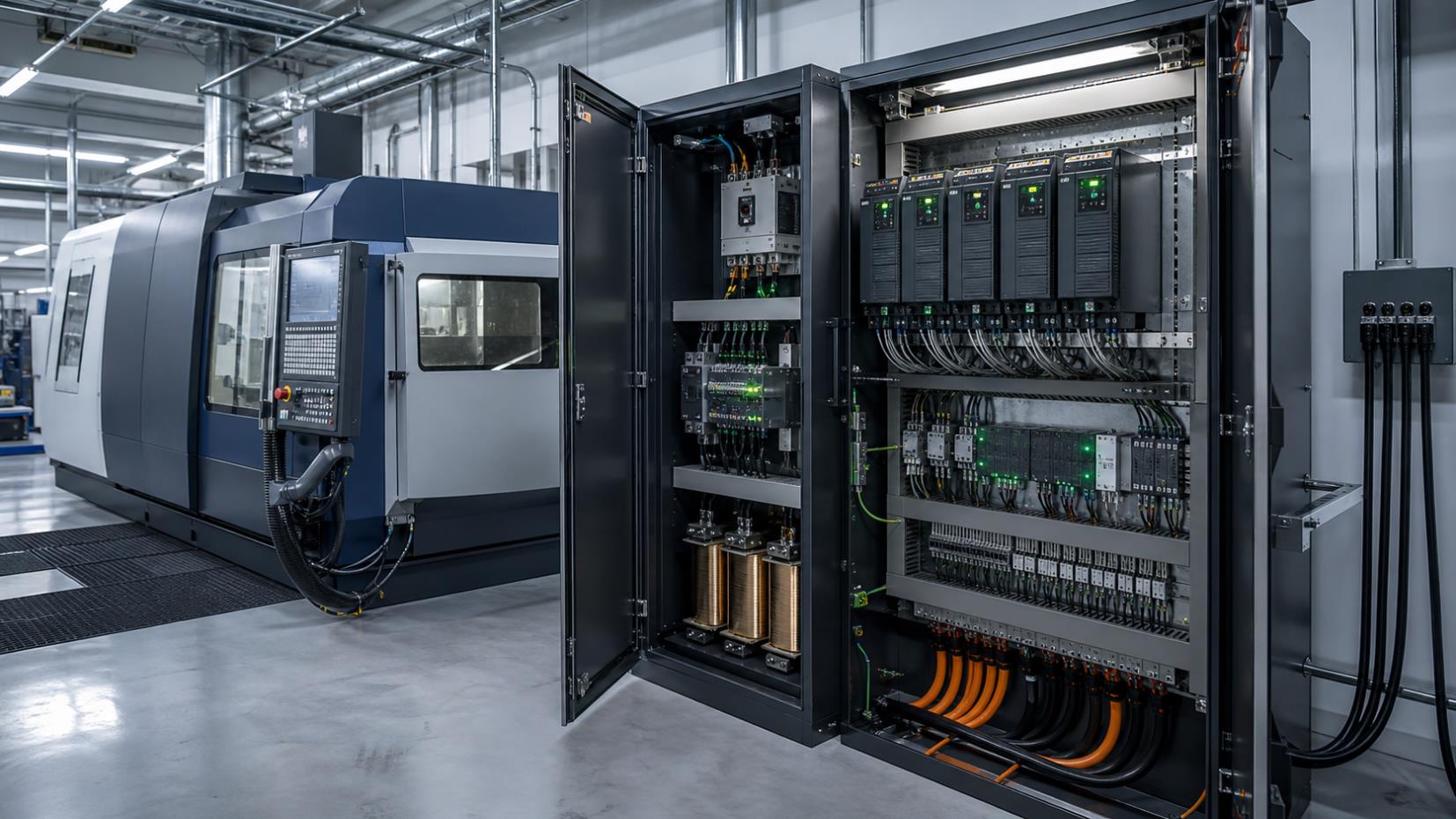
A CNC machine requires continuous, clean electrical power to coordinate the CNC control, axis servos, spindle drive, PLC and auxiliary systems. Voltage disturbances can interrupt motion control, corrupt communication and reduce electronic component life.
Control Stability
Stable power helps the CNC controller, PLC and network maintain reliable data and communication.
Motion Reliability
Servo and spindle drives depend on a consistent input supply for controlled acceleration, speed and position.
Production Continuity
Fewer nuisance alarms, resets and failures reduce downtime, reinitialization and lost work.
2. Common Power Problems That Affect CNC Equipment
| Power issue | Possible CNC symptoms | Long-term risk |
|---|---|---|
| Overvoltage | Overvoltage alarms and drive trips | Accelerated aging of controllers, drives and power modules |
| Undervoltage | Freezing, unexpected restart, parameter loss and interrupted cycles | Contactor problems, unstable electronics and production delays |
| Voltage fluctuation | Motor instability, relay chatter and random interruptions | Reduced process stability and shorter component life |
| Surge voltage | System crash, communication error or immediate hardware failure | Insulation breakdown and costly controller or drive damage |
| Harmonic distortion | False alarms, controller resets and communication failures | Heating, parameter corruption and unstable operation |
3. How CNC Voltage Stabilizers Protect Machine Tools
A CNC-specific voltage stabilizer continuously monitors the incoming supply and corrects unacceptable variation before it reaches sensitive electronics. Industrial systems may combine voltage regulation, isolation, harmonic mitigation, surge suppression and electrical protection.
4. Precise Voltage Regulation
Depending on its design and rating, a high-quality stabilizer may accept an incoming variation of approximately plus or minus 20 percent while maintaining output accuracy near plus or minus 1 percent. Actual limits must be confirmed from the stabilizer and CNC machine specifications.
Input Monitoring
The regulator continuously measures the supply and detects overvoltage, undervoltage and changing line conditions.
Controlled Output
The system adjusts the output to keep the CNC supply within a defined operating band and reduce repeated alarms.
Correct regulation supports consistent machine behavior, but the stabilizer must be sized for the combined load, starting current, regenerative energy and rapid demand changes of the machine tool.
5. Harmonic Filtering and Surge Protection
Harmonic Mitigation
Nonlinear loads such as drives and power supplies generate harmonic currents. Suitable filtering or power-quality equipment can reduce interference affecting CNC controls, servo systems, PLC communication and plant distribution equipment.
Surge Protection
Coordinated surge-protective devices divert transient energy caused by switching events or lightning. This helps protect CNC controllers, servo amplifiers, spindle drives, power modules and communication interfaces.
Fewer Interruptions
Cleaner power reduces nuisance trips, false alarms and unexpected resets.
Lower Maintenance Risk
Protection reduces electrical stress on expensive electronic assemblies.
Longer Equipment Life
Stable voltage and controlled transients help slow insulation and component aging.
6. CNC Voltage Stabilizer Selection Checklist
Machine and Supply Data
Rated voltage, frequency and phase
Maximum kVA and current demand
Servo and spindle acceleration load
Regenerative drive characteristics
Measured input-voltage range
Existing transformer and grounding system
Protection and Installation
Output accuracy and response time
Overload and bypass capability
Surge protection coordination
Harmonic filtering requirements
Ventilation and environmental rating
Qualified electrical installation and maintenance access
A power-quality survey should be performed before equipment selection. Data logging can distinguish voltage variation, short interruptions, transients, harmonics and machine-side faults that may appear similar.
7. CNC Electrical Symptoms and First Checks
| Observed symptom | Power-quality check | Also inspect |
|---|---|---|
| Repeated overvoltage alarms | Record line voltage and switching events | Drive regeneration, braking unit and machine parameters |
| Random controller reset | Check dips, short interruptions and harmonics | Control power supply, loose terminals and heat |
| Parameter or data corruption | Review interruptions, grounding and electrical noise | Backup battery, storage media and network |
| Servo or spindle trip | Measure voltage during acceleration and heavy cutting | Motor load, drive condition and mechanical binding |
| Communication errors | Check harmonics, grounding and transient events | Cable shielding, connectors and network configuration |
Benefits of Stable CNC Power
Higher machine reliability and fewer electrical alarms
Reduced downtime and production interruption
More stable servo, spindle and controller operation
Longer electronic component life
Lower repair and maintenance cost
More consistent performance across multiple production lines
Power stabilization does not directly create dimensional accuracy, but it supports the reliable control and motion systems required for consistent precision machining.
Frequently Asked Questions
Is a voltage stabilizer the same as a surge protector?
No. A stabilizer regulates sustained voltage variation, while a surge protector responds to short transient spikes. Industrial installations may require both.
Can a general-purpose stabilizer be used for CNC machines?
Only if its electrical design, capacity, response, overload behavior and compatibility meet the CNC manufacturer's requirements. Machine tools can have rapid and regenerative loads.
Will a stabilizer eliminate all CNC alarms?
No. It can reduce alarms caused by poor supply voltage, but mechanical, drive, parameter, sensor, cooling and connection faults must be diagnosed separately.
How should stabilizer capacity be selected?
Use measured and manufacturer-specified demand, including peak and dynamic load, not only the average machine rating. A qualified electrical engineer should confirm sizing.
Why is a power-quality survey recommended?
Different disturbances require different solutions. Logging identifies whether the problem is voltage variation, interruption, transient surge, harmonic distortion or an internal machine fault.
Conclusion
Stable electrical power is an important foundation for reliable CNC machining. Overvoltage, undervoltage, fluctuation, surges and harmonic distortion can interrupt production and damage sensitive controls, drives and communication equipment.
A correctly selected CNC voltage stabilizer, combined with sound grounding, coordinated surge protection and verified power quality, can reduce downtime, extend electronic component life and protect valuable manufacturing assets.
Industrial electrical work must be designed, installed and serviced by qualified personnel according to local regulations and the machine and equipment manufacturers' requirements.