What makes someone a true CNC programming master? Many people assume that expertise requires eight or ten years in the industry. Yet time alone does not guarantee progress. A programmer who repeats the same tasks for years may develop less capability than someone who continuously studies, analyzes problems, and improves machining processes.
Real CNC programming expertise combines technical knowledge, machining experience, attention to detail, communication, and the ability to balance quality, safety, efficiency, tooling cost, and delivery requirements.
The Five Essential Qualities of a Great CNC Programmer
Humility
Attention to Detail
Patience
Responsibility
Teamwork
1. Humility
CNC technology, CAM software, cutting tools, and manufacturing requirements continue to evolve. A capable programmer remains open to new knowledge and learns from operators, tool suppliers, technicians, and other engineers.
2. Attention to Detail
Small errors in coordinate systems, tool selection, allowances, model orientation, boundaries, or cutting parameters can compromise an entire part. Precision programming depends on verifying details before machining begins.
3. Patience
Complex parts rarely produce an ideal process on the first attempt. Skilled programmers patiently analyze geometry, simulate toolpaths, refine engagement, and solve machining problems instead of accepting unstable results.
4. Responsibility
A programmer is responsible for more than generating code. The program must support machine safety, production efficiency, part quality, reliable setup, and clear understanding by the operator.
5. Appreciation and Teamwork
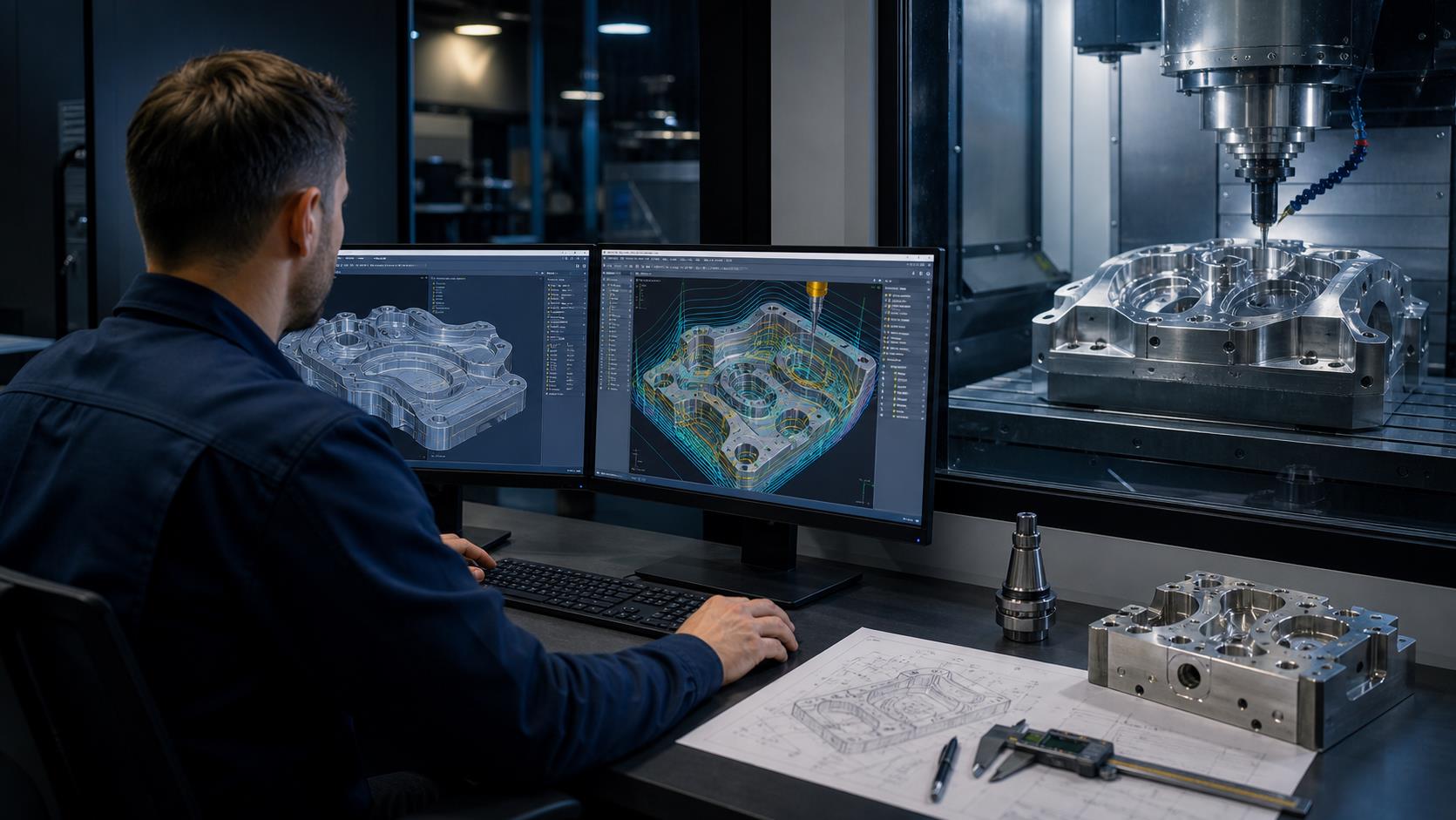
Practical programs are created through communication with machine operators, mold technicians, engineers, inspection personnel, and production managers. Their feedback connects digital toolpaths with real manufacturing conditions.
What Defines a CNC Programming Master?
The highest level of CNC programming is not creating the most complicated program. It is using the simplest suitable toolpaths and the fastest reliable manufacturing method to produce a part that meets the customer's actual requirements.
A true expert balances:
Machining efficiency
Tool life and reliability
Tooling and production cost
Part function and tolerance
Surface requirements
Delivery schedule
Core principle: The best program is the one that achieves the required result safely, economically, and consistently—not the one that looks most impressive on the screen.
Simple Toolpaths Require Professional Thinking
Simplicity does not mean careless or basic programming. A concise toolpath can reflect deep knowledge of machine behavior, tool engagement, workholding, stock condition, and downstream operations.
Before selecting a machining strategy, an experienced programmer considers:
Machine capability and travel
Mold or component structure
Workpiece clamping and rigidity
EDM requirements
Machining direction and accessibility
Polishing or texturing requirements
Tool availability and cost
Production and delivery schedule
Faster Machining Does Not Always Mean Fewer Toolpaths
Beginners sometimes assume that fewer programs automatically reduce machining time. In practice, several well-designed toolpaths can be faster than one long, inefficient path.
Separating the job by geometry or machining purpose can reduce unnecessary air cutting, tool lifting, overload, and repeated passes. For example:
Model area clearance can provide controlled bulk material removal.
Constant Z machining can efficiently process steep walls and reduce unnecessary movements.
Reference-line machining can improve control in selected local regions.
Parallel or dedicated finishing strategies can match different surface directions and requirements.
The programmer's skill lies in knowing when each method adds value and when it only adds complexity.
Customer Satisfaction Is More Than Surface Finish
An inexperienced programmer may spend excessive machine time chasing a perfect-looking surface everywhere. However, not every area requires polishing-level tool marks.
A professional first understands the part's function, mold structure, texture requirements, downstream finishing, tolerance, production target, and delivery date. If a surface will later receive EDM, texturing, grinding, or manual polishing, unnecessary CNC finishing may increase cost without adding customer value.
The Real Goal
Complete the specified machining quality in the shortest reliable time, protect critical features, and deliver the product on schedule.
Preparation Before CNC Programming
Before creating roughing toolpaths, the model, stock, coordinate system, and machining direction must be confirmed. Even an excellent toolpath is useless if the initial setup is wrong.
Verify the ModelConfirm the correct part, revision, mold core or cavity, material, and machining scope.
Define OrientationDecide model direction, X-axis, datum surface, origin location, and whether positioning is centered or side-referenced.
Confirm with ProductionExplain workpiece direction, setup, material, machining method, and special requirements to operators and technicians.
Common preparation mistakes include selecting the wrong material, confusing mold cores and cavities, using an incorrect model orientation, and setting the workpiece origin incorrectly.
Rough Machining Strategy
Roughing is usually the first and often the longest machining stage, so its optimization has a major influence on total cycle time. Model area clearance is one commonly used approach, but the strategy must be adapted to the part and machine.
Select Tools for Production Value
Tool choice affects material-removal rate, reliability, machine power, reach, and cost. The most expensive cutter is not automatically the most economical. Evaluate actual time savings, insert life, breakage risk, and availability.
Set a Practical Machining Allowance
Too much stock increases the workload of subsequent operations. Too little stock creates overcutting risk and may not leave enough material to remove roughing marks or distortion. Allowance must reflect tool radius, part geometry, rigidity, and finishing method.
Optimize Entry, Exit, and Engagement
Smooth arc or angled entry can reduce impact and stabilize cutting. Tool overload and choking can be controlled through appropriate cutting parameters, engagement thresholds, corner smoothing, transition radii, and shorter unnecessary lead movements.
Check Remaining Stock and Accessibility
Simulation and stock analysis should confirm that every required region is reachable. When material remains, adjust stock dimensions, boundaries, tool selection, or create additional local machining regions.
No single fixed rule: Expert programmers select and combine strategies according to geometry, machining requirements, machine capability, tooling, and production goals.
Semi-Roughing and Intermediate Finishing
After primary roughing, a medium-size tool may remove remaining stock and prepare a consistent allowance for final finishing. Constant Z machining is often useful on steep regions, while other surfaces may require dedicated rest-machining or finishing paths.
Important controls include:
Add sufficient stock to prevent tool compression
Use a suitable stepdown for stable loading
Remove unnecessary or duplicate paths
Check rest material and local boundaries
Prevent overcutting near transitions
Prepare uniform stock for final finishing
CNC Programming Review Checklist
Confirm model revision, material, stock, orientation, and coordinate system.
Verify workholding, machine travel, tool reach, and collision clearance.
Select tools according to both performance and production cost.
Match roughing, rest machining, and finishing strategies to the geometry.
Check allowances, boundaries, entry moves, transitions, and tool engagement.
Simulate the complete process and inspect remaining stock.
Confirm critical tolerances and downstream EDM, polishing, or texturing.
Provide operators with clear setup, tool, datum, and machining information.
Frequently Asked Questions
How many years does it take to become an expert CNC programmer?
There is no fixed number. Deliberate learning, varied machining experience, process analysis, and continuous improvement matter more than simply accumulating years.
Is the shortest CNC program always the fastest?
No. Several specialized toolpaths may reduce air cutting, lifting, overload, and repeated passes, producing a shorter total cycle than one large general-purpose path.
What should be checked before generating toolpaths?
Verify the model and revision, material, stock, origin, axis direction, setup, workholding, machine capability, tolerances, and downstream process requirements.
Why is operator communication important?
Operators understand machine behavior, setup constraints, chip control, and practical risks. Their feedback helps make programs safer, clearer, and more reliable.
What is the real objective of CNC programming?
The objective is to transform digital models into conforming physical parts through safe, efficient, economical, and repeatable machining decisions.
Conclusion
A CNC programming master is not defined by years of experience or complicated toolpaths. True expertise combines technical knowledge, practical machining understanding, careful preparation, problem-solving, responsibility, and teamwork.
The best programmers balance toolpath simplicity, machining time, tool life, production cost, part quality, and customer requirements. They do not merely write code—they build reliable manufacturing processes.