What does it really take to become a true CNC machining expert? There is no single skill or shortcut. Modern CNC manufacturing combines process engineering, programming, machine operation, fixture design, precision measurement, maintenance, troubleshooting, and years of hands-on learning.
For many professionals, becoming a qualified CNC technician requires five to six years of continuous practice. As manufacturing becomes more specialized, mastering only one task is no longer enough. A complete CNC professional keeps learning and connects digital planning with reliable shop-floor execution.
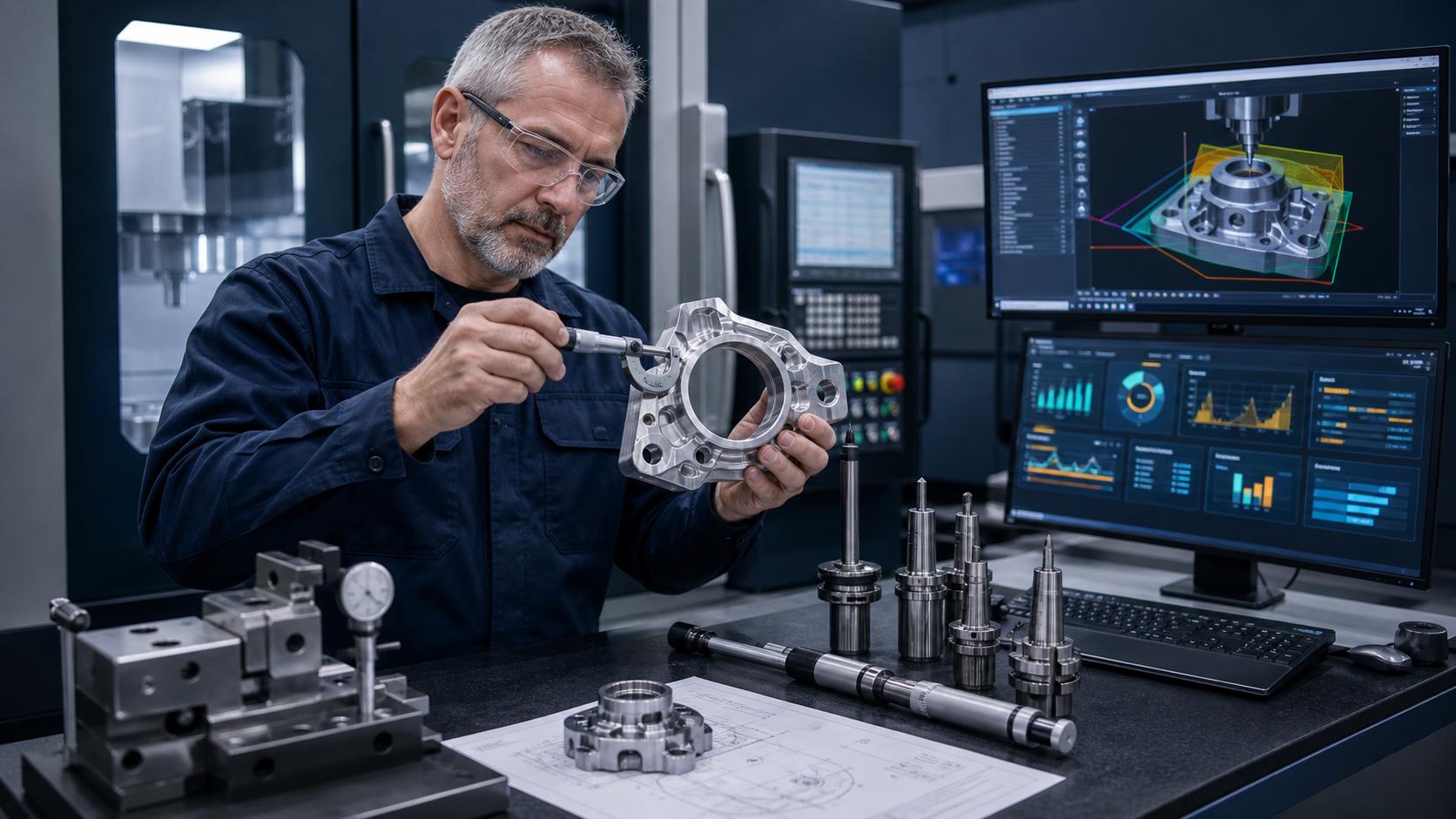
The Complete CNC Expert Skill Set
Process Planning
CNC Programming
Machine Operation
Fixtures & Workholding
Precision Measurement
Machine Maintenance
1. Master CNC Machining Processes
A CNC expert must first become a capable manufacturing process engineer. Modern machining centers combine drilling, milling, boring, reaming, tapping, and other operations in one coordinated process.
Early career development should include hands-on experience beside skilled operators using CNC lathes, milling machines, grinders, and machining centers. That shop-floor knowledge should then be connected to process planning, material estimation, cycle-time calculation, routing, and manufacturing documentation.
Essential Process Engineering Knowledge
Machine structures and process capabilities
Material properties and machinability
Cutting-tool theory and cutting parameters
Machining standards and procedures
Process planning for common components
Tooling systems used in machining centers
Coolant selection and maintenance
Casting, EDM, and heat-treatment basics
Fixture-design fundamentals
Assembly and functional requirements
Precision measurement techniques
Production-time and cost awareness
Professional judgment: Process knowledge becomes valuable when it can balance accuracy, safety, efficiency, tool life, and production cost on a real machine.
2. Become Proficient in CNC Programming and CAD/CAM
Learning basic G-code structures is relatively straightforward because many CNC controls use similar motion, tool, spindle, compensation, and cycle concepts. Efficient programming, however, requires far more than memorizing commands.
Professional programmers should understand 3D modeling, toolpath creation, stock definition, collision checking, machining simulation, post-processing, and process optimization.
Characteristics of Excellent CNC Programs
Clear, organized programs are easier to verify, maintain, and operate safely.
Minor dimensional corrections should use appropriate offsets instead of unnecessary code changes.
Programs should support monitoring, inspection, measurement, and safe recovery on the actual machine.
In manufacturing, the simplest reliable solution is often the most effective because it reduces ambiguity, setup time, and production risk.
3. Develop Strong CNC Machine-Operation Skills
Programming knowledge alone does not create a complete CNC professional. Machine operation provides the practical understanding needed to judge whether a planned process will work reliably under real cutting conditions.
Essential operating skills include:
Machine-control and mode operation
Fixture installation and verification
Workpiece alignment and centering
Tool setting and offset management
Work-coordinate setup
Tool-length and radius compensation
Tool installation and removal
Cutting-edge maintenance where applicable
Safe first-piece prove-out
Precision part measurement
Experienced programmers often participate directly in first-piece machining. Observing spindle load, chip formation, sound, coolant delivery, deflection, and measurement results confirms whether the process behaves as expected.
4. Understand Fixtures and Workholding
Machine accuracy cannot compensate for poor workholding. Incorrect location, unsupported cutting zones, excessive or uneven clamping force, and weak fixtures can cause dimensional error, vibration, distortion, and poor surface finish.
Many first-piece failures originate from:
Unreliable datum selection
Incorrect locating methods
Poor clamping-point placement
Excessive or insufficient clamping force
Limited tool access or chip evacuation
Insufficient support near the cutting area
A CNC expert evaluates the entire machining system—machine, spindle, holder, tool, fixture, workpiece, and toolpath—rather than treating each element separately.
5. Master Precision Measurement
Reliable measurement is one of the most fundamental machining abilities. Although coordinate measuring machines are widely used, manual metrology remains essential for setup, in-process verification, troubleshooting, and fast production decisions.
Professional machinists should confidently select and use:
Vernier and digital calipers
Outside and inside micrometers
Dial and test indicators
Bore gauges
Height gauges
Gauge blocks and setting standards
Thread and plug gauges
CMM reports and inspection data
Measurement expertise includes instrument condition, calibration awareness, correct contact force, temperature effects, datum strategy, repeatability, and understanding what the drawing actually requires.
6. Learn CNC Machine Maintenance
A complete CNC expert understands enough machine structure to recognize abnormal conditions before they become major failures or quality problems.
CNC electrical systems and alarm diagnosis
Ball screws and axis transmission
Spindle systems and tool interfaces
Lubrication and hydraulic systems
Coolant systems and filtration
Guideways and way protection
Automatic tool changers
Positioning accuracy and calibration
Daily Preventive Maintenance
Good daily habits include monitoring axis and spindle load, checking lubricant consumption, cleaning electrical-cabinet filters, maintaining coolant concentration and cleanliness, inspecting tool interfaces, and recording abnormal machine behavior.
Consistent preventive maintenance supports machine reliability, dimensional accuracy, surface quality, and longer equipment life.
7. Develop the Right Professional Mindset
Technical ability is essential, but professional habits determine how that knowledge is applied under production pressure.
Think Before MachiningPlan coordinate systems, setups, tools, transformations, clearances, and recovery before cycle start.
Work as a TeamCooperate with operators, programmers, inspectors, fixture designers, engineers, and maintenance personnel.
Prioritize SafetyUnderstand exactly how the machine will move and verify programs, offsets, compensation, tools, and workholding.
Stay CalmWhen production problems occur, stop, collect evidence, analyze logically, and avoid creating a second error.
Keep LearningStudy new tooling, CAM functions, machining strategies, automation, measurement technology, and standards.
Take ResponsibilityDocument decisions, protect quality, communicate risks, and follow issues through to verified resolution.
Defining characteristic: A true CNC professional remains curious even after becoming experienced. Manufacturing technology never stops evolving.
CNC Expert Development Checklist
Build strong fundamentals in materials, tools, parameters, and machining processes.
Gain hands-on experience with lathes, mills, grinders, and machining centers.
Learn G-code, CAD/CAM, simulation, and safe post-processing.
Become competent in setup, alignment, tool setting, offsets, and first-piece prove-out.
Study fixture design, clamping force, datum selection, and part deformation.
Practice manual measurement and understand inspection reports.
Learn preventive maintenance, machine alarms, and accuracy checks.
Develop teamwork, safety awareness, calm troubleshooting, and continuous learning.
Frequently Asked Questions
How long does it take to become a qualified CNC technician?
Many people require approximately five to six years of continuous learning and varied practical experience, although progress depends on training quality, job exposure, effort, and problem-solving opportunities.
Is CNC programming enough to become an expert?
No. A complete professional also needs process planning, machine operation, workholding, measurement, maintenance, safety, and hands-on troubleshooting skills.
Why should programmers operate machines?
Machine operation reveals practical issues such as setup access, chip evacuation, spindle load, vibration, compensation, tool wear, and operator usability that may not be obvious in CAM software.
Why is manual measurement still important?
Manual tools support fast setup checks, in-process decisions, first-piece verification, and troubleshooting even when final inspection uses a CMM.
What is the most important mindset for CNC professionals?
Think carefully before machining, prioritize safety, base decisions on evidence, remain calm during problems, collaborate with others, and continue learning throughout your career.
Conclusion
Becoming a true CNC machining expert requires far more than operating a machine or writing G-code. Professional capability comes from integrating process planning, programming, machine operation, fixture knowledge, precision measurement, maintenance, safety, teamwork, and continuous improvement.
There are no shortcuts. With strong fundamentals, varied practical experience, and a disciplined commitment to learning, machinists can build the judgment required to solve complex manufacturing problems and deliver consistent, high-quality parts.