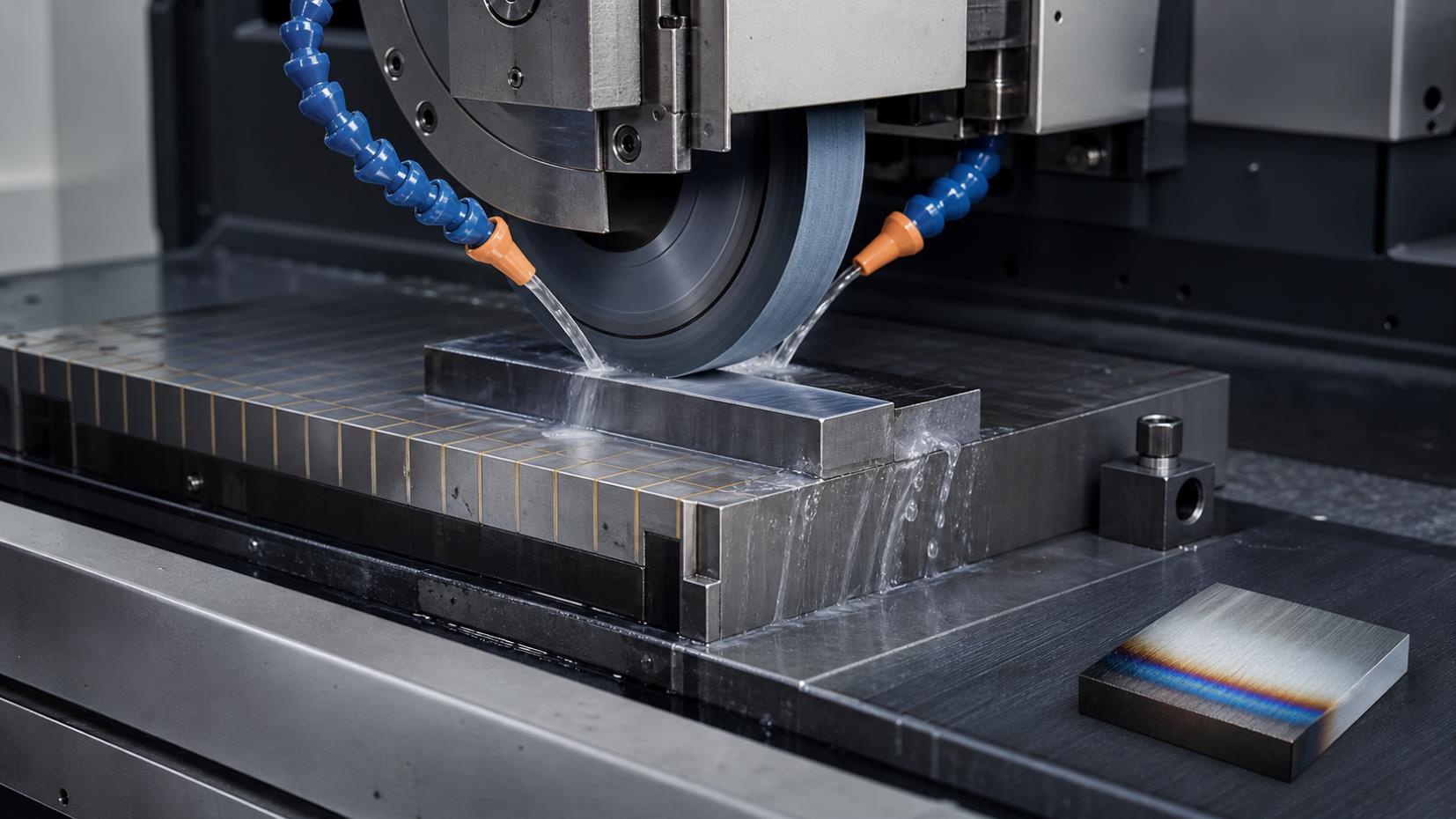
Grinding is an essential finishing process for precision components, but excessive heat can cause grinding burn. This thermal defect may discolor the surface, alter the metallurgical structure, reduce fatigue strength and shorten component life.
Effective prevention requires control of heat generation and heat removal across the complete process, including wheel specification, dressing, coolant delivery, machine condition, workholding and grinding parameters.
1. What Causes Grinding Burn?
Thousands of abrasive grains cut, plow and rub against the workpiece simultaneously. Heat comes from plastic deformation, internal friction in the material, high-speed wheel contact and the momentary action of each abrasive grain.
Because each cutting event occurs quickly, heat may accumulate faster than it can move into the wheel, workpiece, chips and coolant. The contact zone can reach approximately 800 to 1,500 degrees C. If heat removal is inadequate, localized overheating damages the surface.
2. Effects of Grinding Burn
Metallurgical Damage
Surface re-hardening, secondary quenching, high-temperature tempering and structural transformation.
Performance Loss
Reduced fatigue strength, lower wear resistance and shorter component service life.
Visible and Hidden Defects
Severe burn may appear yellow, brown, blue or black. Slight burn can require controlled chemical etching or other inspection methods.
3. How to Prevent Grinding Burn
Optimize Grinding Fluid Performance
Coolant must reach the active grinding zone rather than bounce away from the wheel air barrier. Concentration, flow, pressure, nozzle position, filtration, lubrication and cleaning action all influence temperature and wheel loading.
Reduce Heat Generation
Reduce grinding depth where appropriate
Minimize rubbing and plastic deformation
Use stable feed and workpiece speed
Prevent excessive stock removal in one pass
Keep the wheel sharp and open
Improve Heat Dissipation
Deliver sufficient coolant flow
Position nozzles at the contact zone
Maintain correct fluid concentration
Remove swarf through filtration
Avoid interruptions in coolant supply
4. Select and Maintain the Proper Grinding Wheel
A wheel that is too hard or too dense can retain dull grains, load with workpiece material and create excessive rubbing. Wheel specification must balance cutting ability, form retention, surface finish and self-sharpening.
| Operation | General wheel strategy | Process emphasis |
|---|---|---|
| Rough grinding | Softer grade and more open structure | Chip space, self-sharpening and higher stock removal |
| Finish grinding | Finer structure and suitable form-retaining grade | Small allowance, accuracy and surface finish |
| Burn-sensitive materials | Sharp, free-cutting wheel matched to hardness and conductivity | Lower heat generation and stable cutting |
Wheel Dressing
Regular dressing removes loaded material, exposes sharp abrasive grains and restores wheel geometry. Dressing parameters and dresser position must remain consistent; insufficient dressing allows rubbing, while excessive dressing reduces wheel life.
5. Common Causes and Corrective Actions
| Observed condition | How it creates burn | Corrective action |
|---|---|---|
| Machine vibration | Creates periodic changes in instantaneous grinding depth | Check spindle, bearings, balance, workholding and table motion |
| Dull or loaded wheel | Replaces cutting with rubbing and increases contact heat | Dress the wheel and review grade, structure and coolant cleaning |
| Weak workpiece support | Allows movement and localized heavy removal | Improve fixture rigidity and holding force |
| Uneven grinding allowance | Creates changing force and localized overload | Control incoming stock and distribute removal across passes |
| Excessive depth or feed | Raises power, force and heat input | Reduce infeed or feed and add controlled passes |
| Poor coolant delivery | Fails to lubricate, clean and remove heat | Correct nozzle position, flow, pressure, concentration and filtration |
6. Grinding Burn in Different Operations
Surface Grinding
Check spindle runout, worn bearings, magnetic chuck vibration, weak holding force, table instability and reciprocating impact. Stable spindle accuracy and workholding are essential.
Double-Disc Grinding
Worn feed guide plates, guide-to-wheel misalignment, insufficient entry angle and uneven wheel loading can create nonuniform heat. Maintain guide geometry and balanced wheel condition.
Cylindrical and Centerless Grinding
Slide stick-slip, excessive infeed, incorrect spark-out, control instability and sudden interruptions can create local overload. Calibrate feeds and verify smooth machine motion.
Internal Grinding
Long contact arcs, restricted chip evacuation and difficult coolant access make internal grinding burn-sensitive. Improve coolant penetration, dress frequently and maintain reliable wheel compensation.
Raceway Grinding
Oscillating operations benefit from strong wheel self-sharpening, while plunge operations require form retention, frequent dressing and sufficient coolant. Dresser position and compensation must remain consistent.
7. Grinding Burn Prevention Checklist
Before Production
Confirm wheel specification and condition
Verify dressing tool position
Check coolant concentration and filtration
Confirm nozzle flow reaches the contact zone
Inspect workholding and incoming allowance
During Production
Monitor grinding power, sound and vibration
Watch for wheel loading and finish changes
Maintain stable depth, feed and workpiece speed
Inspect for color changes or etch indications
Dress before cutting efficiency deteriorates
Frequently Asked Questions
Is all grinding burn visible?
No. Severe burn may create oxidation colors, but slight metallurgical damage can be invisible and may require chemical etching or another validated inspection method.
Why can a hard grinding wheel increase burn risk?
An excessively hard wheel may hold dull grains instead of releasing them. The grains rub rather than cut, raising force and temperature.
Does adding more coolant always solve grinding burn?
Not by itself. Coolant must have the correct condition and reach the contact zone. Wheel sharpness, parameters, machine stability and workholding must also be controlled.
Why is internal grinding especially sensitive?
The contact arc is longer, coolant access is restricted and chip evacuation is difficult, so heat accumulates more easily.
How does vibration create periodic burn marks?
Vibration repeatedly changes the actual grinding depth and force, producing localized temperature peaks that follow the vibration pattern.
Conclusion
Grinding burn is a thermal surface-integrity defect caused by excessive heat generation and inadequate heat removal. It can reduce fatigue strength, wear resistance, dimensional reliability and component life.
Manufacturers can reduce the risk by selecting a suitable wheel, dressing it consistently, optimizing depth and feed, directing clean coolant into the contact zone, controlling vibration and maintaining stable workholding. The best results come from treating grinding as a complete system rather than changing one parameter in isolation.
Grinding parameters and burn-detection methods should be validated for the actual material, heat treatment, wheel specification, machine and customer requirements.