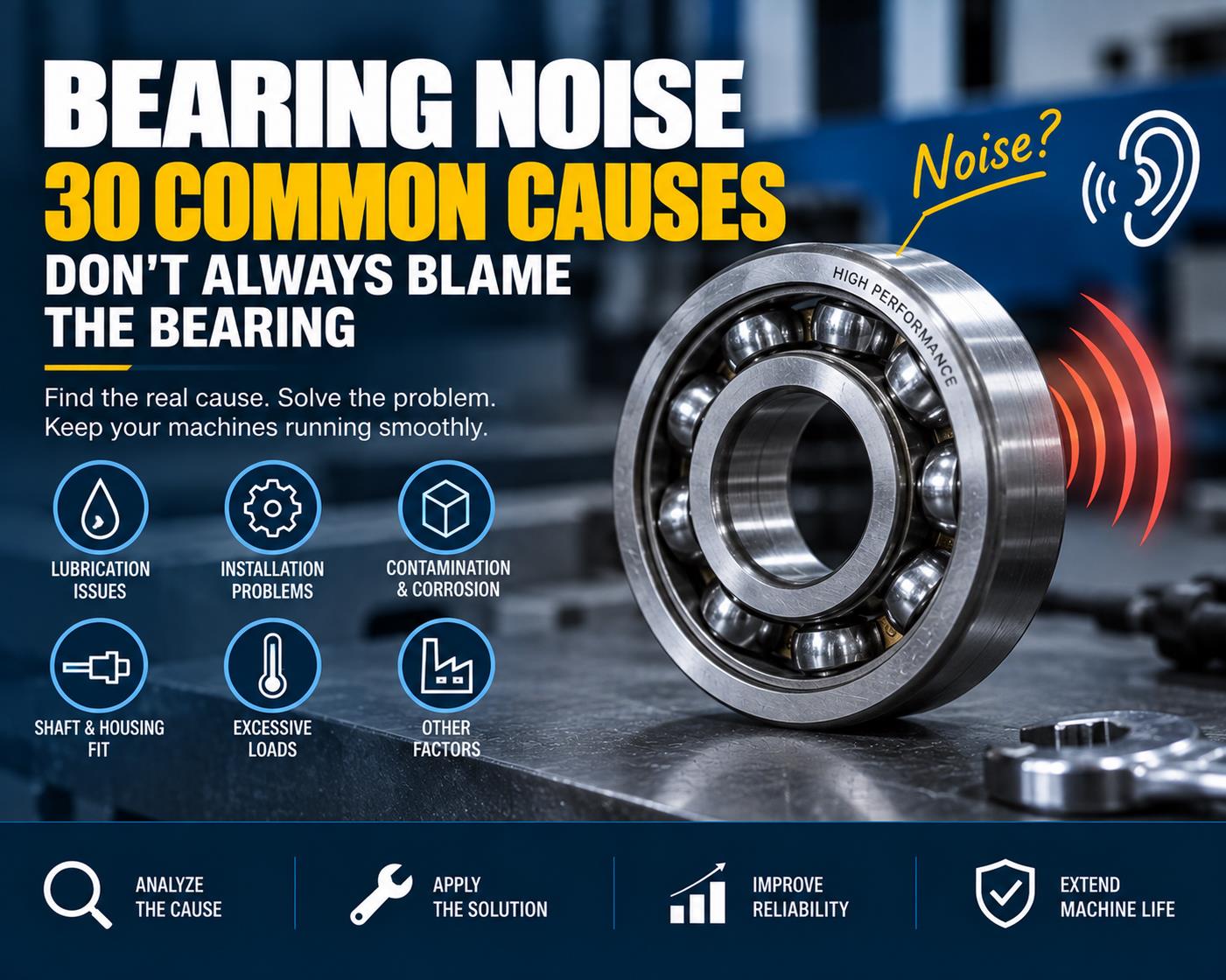
When a newly installed bearing makes abnormal noise, it is easy to assume the bearing itself is defective. In practice, bearing noise can originate from lubrication, contamination, clearance, installation, shaft and housing fits, seals, loads, external vibration or damage.
This bearing troubleshooting guide summarizes 30 common causes so maintenance personnel can inspect the complete bearing system before returning or replacing the bearing.
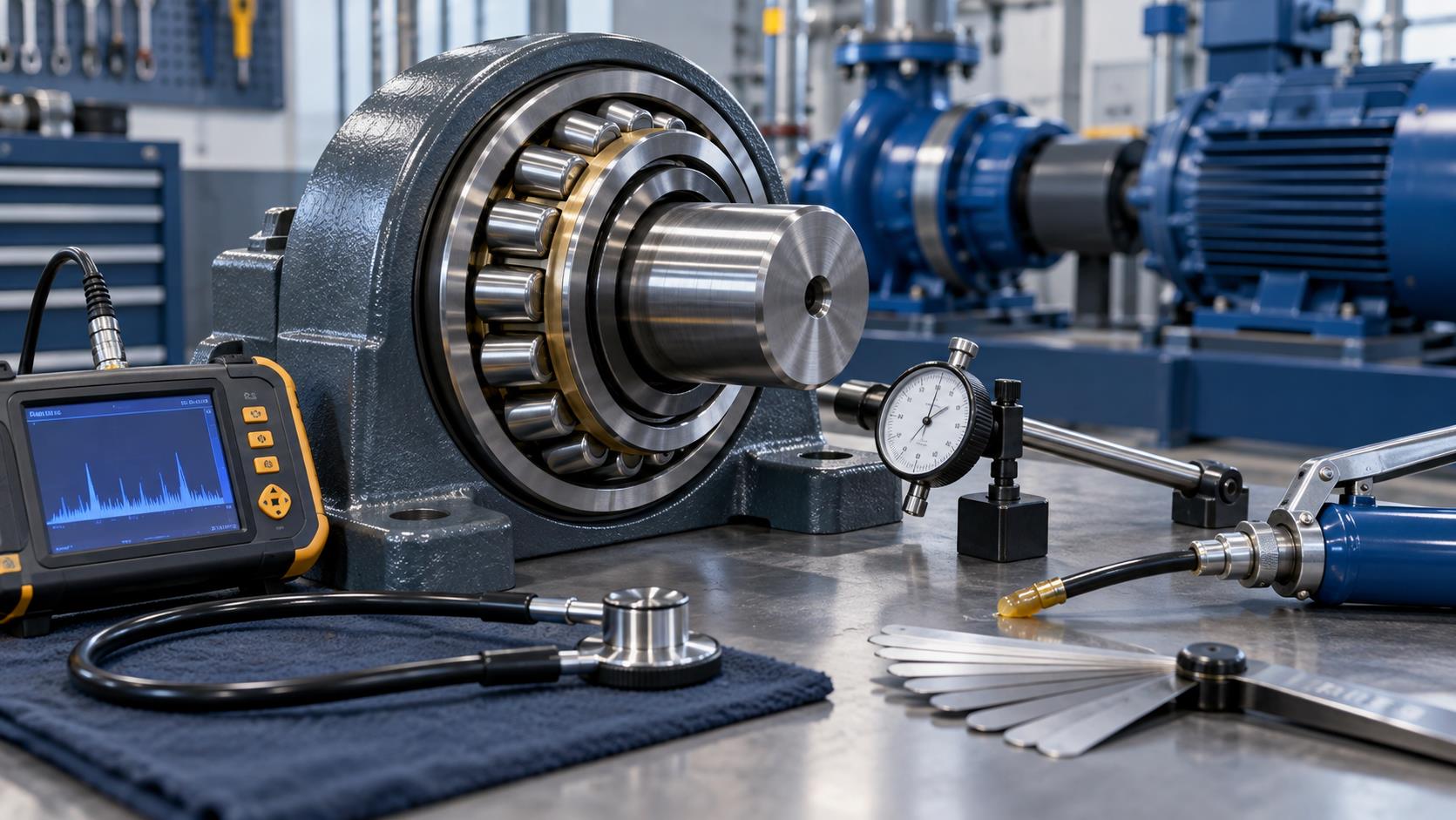
1. Lubrication, Clearance and Contamination
1.1 Contaminated Grease
Impurities in grease interfere with smooth rolling contact and produce abnormal sound.
1.2 Insufficient Lubrication
Low oil level, leakage or poor storage can leave the bearing without an adequate lubricating film.
1.3 Incorrect Bearing Clearance
Internal clearance that is too small or too large changes rolling-element motion and load distribution.
1.4 Abrasive Contaminants
Sand, carbon particles and similar matter act as abrasives and damage rolling surfaces.
1.5 Corrosive Contaminants
Water, acid, paint and other contamination can corrode bearing surfaces and create noise.
2. Housing, Assembly and Surrounding Components
2.1 Housing Bore Distortion
An out-of-round or misaligned housing bore can squeeze and deform the bearing.
2.2 Uneven Housing Shims
Uneven shims distort the housing bore and may contribute to housing cracks.
2.3 Debris in the Housing Bore
Machining chips or dust left during assembly prevent correct seating.
2.4 Eccentric Seal Ring
An eccentric ring may rub adjacent parts, creating noise that resembles a bearing fault.
2.5 Oversized Shaft Shoulder
A large shoulder may contact the bearing seal and generate friction.
2.6 Oversized Housing Shoulder
The internal shoulder may contact or distort the seal.
2.7 Small Labyrinth Clearance
A labyrinth seal with insufficient clearance can rub the shaft.
2.8 Bent Lock-Washer Teeth
Incorrectly bent teeth may contact the bearing.
2.9 Incorrect Oil-Slinger Position
A misplaced oil slinger may rub the flange cover and generate abnormal sound.
3. Bearing Fits, Clearance and Additional Loads
3.1 Unintended Additional Loads
Excess axial constraint or two fixed bearings on one shaft can impose unwanted loading.
3.2 Loose Bearing-to-Shaft Fit
An undersized shaft or loose adapter sleeve can create unstable movement.
3.3 Clearance Too Small
Excessive adapter-sleeve tightening can reduce internal clearance and make rotation tight.
3.4 Sliding Rolling Elements
Sliding balls or roller end faces generate friction and abnormal noise.
3.5 Shaft Thermal Expansion
Excess expansion can create additional axial load in a constrained arrangement.
3.6 Oversized Shaft Diameter
Excessive interference can increase temperature and noise.
3.7 Undersized Housing Bore
A bore that is too small creates an overly tight outer-ring fit.
3.8 Oversized Housing Bore
A loose outer-ring fit can cause creep or slipping.
3.9 Enlarged Housing Bore
Stretching in nonferrous housings or thermal expansion can reduce fit security.
4. Damage, Defects and External Vibration
4.1 Dented Balls or Rollers
Hammer impact during installation can indent rolling elements and create periodic noise.
4.2 External Machine Vibration
Vibration transmitted from another component may be mistaken for bearing noise.
4.3 Heating Damage
A heating torch used during removal can discolor or deform bearing components.
4.4 Broken Bearing Cage
A damaged cage interferes with rolling-element guidance and spacing.
4.5 Rusted Raceway
Rolling elements passing over corroded areas produce recurring sound.
4.6 Worn Balls and Raceways
Wear, poor grinding or product impact can damage the rolling contact surfaces.
4.7 Defective Ring Raceway
A raceway that fails manufacturing-quality requirements can be the true source of noise.
5. Bearing Noise Troubleshooting Table
| Inspection area | Typical problem | Recommended check |
|---|---|---|
| Lubrication | Low quantity, wrong condition or contamination | Confirm lubricant type, quantity, cleanliness and leakage |
| Internal clearance | Too tight or too loose | Verify original clearance, fit and installed residual clearance |
| Shaft and housing | Incorrect diameter, roundness, alignment or shoulder | Measure dimensions, geometry and seating surfaces |
| Seals and adjacent parts | Rubbing or interference | Inspect contact marks and operating clearance |
| Loading | Unexpected axial or radial force | Review locating arrangement, thermal growth and machine load |
| Vibration | External excitation | Compare vibration at bearing and surrounding components |
| Bearing components | Cage, roller or raceway damage | Inspect condition and identify periodic defect signatures |
6. A Systematic Inspection Process
6.1 Confirm the Symptom
Record when the noise occurs, its frequency, load, speed, temperature and operating history.
6.2 Inspect External Causes
Check seals, covers, slingers, alignment, foundations and vibration sources before disassembly.
6.3 Verify Lubrication and Fits
Confirm lubricant condition, bearing clearance and shaft and housing dimensions.
6.4 Inspect the Bearing
Only after surrounding causes are checked should the cage, rolling elements and raceways be evaluated for damage or manufacturing defects.
Bearing Noise FAQ
Does abnormal noise always mean the bearing is defective?
No. Lubrication, fits, seals, mounting, loads and external vibration often create noise even when the bearing itself is acceptable.
Can excessive grease cause bearing noise?
Incorrect lubricant quantity or condition can increase churning, heat and unstable operation. Follow the bearing and equipment lubrication specification.
Why does an incorrect fit create noise?
A tight fit can reduce clearance and raise heat, while a loose fit can allow creep, slipping and unstable ring movement.
What should be checked first?
Begin with the operating symptom, lubrication, external rubbing, mounting condition, load and measurable shaft and housing fits.
Zentoc Precision Manufacturing
Zentoc provides CNC machining and custom manufacturing for precision mechanical components.
Contact Zentoc