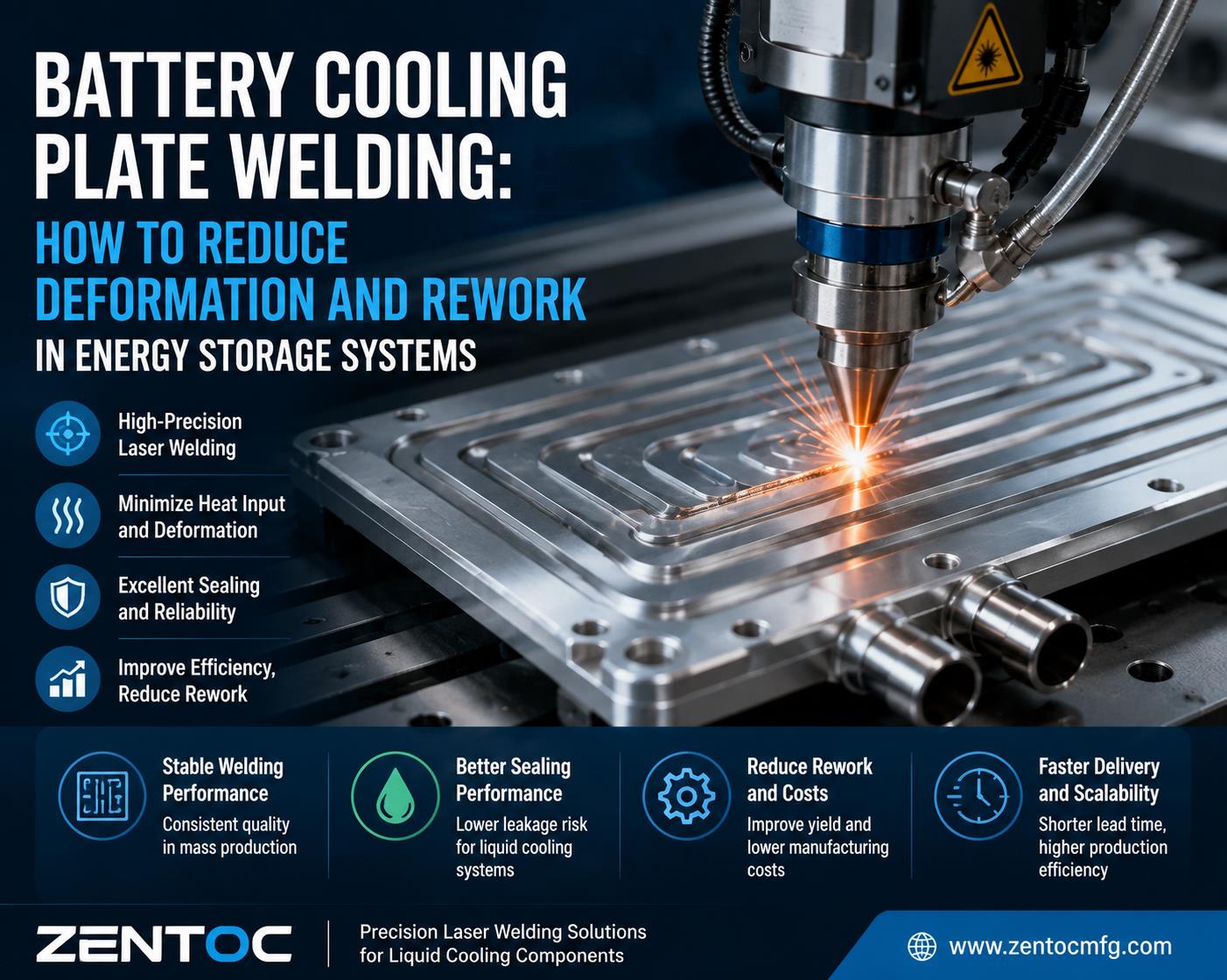
Precision laser welding for energy storage cooling plates uses concentrated laser energy to produce narrow, accurate welds with a smaller heat-affected zone. Compared with conventional welding processes that introduce more heat, laser welding reduces heat transfer into surrounding material and helps control warping, thermal distortion, and post-weld dimensional change.
For cooling plates with complex flow channels and long sealing paths, a stable laser process is essential for air tightness, pressure resistance, surface flatness, and repeatable mass production.
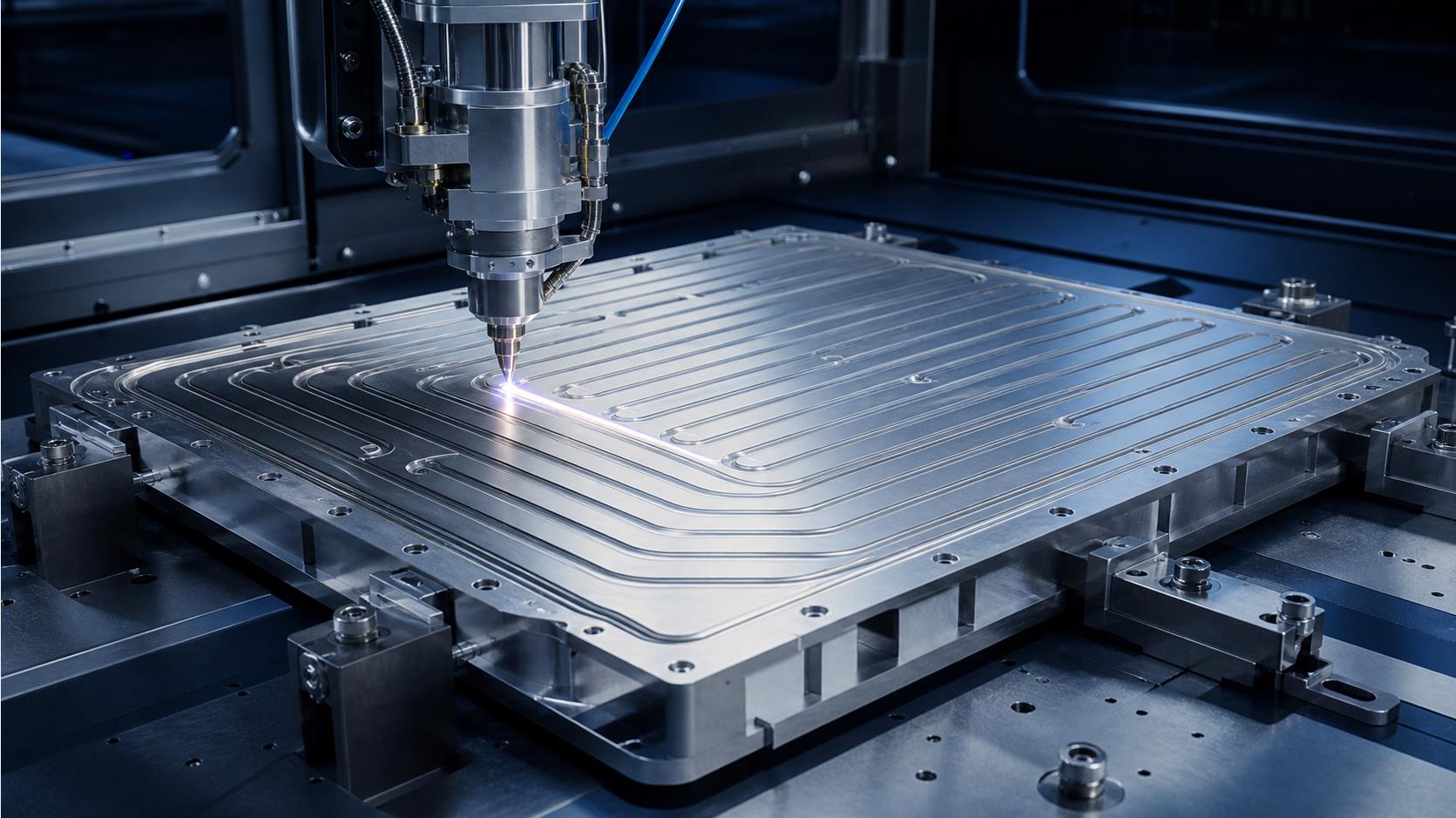
Why Use Laser Welding for Cooling Plates?
A laser focuses energy into a very small area, enabling fast and precise joining with limited heat input. This is particularly valuable for thin aluminum cooling plates, where excessive heat can compromise flatness, flow-channel geometry, and final assembly accuracy.
Compared with many conventional welding methods, a correctly developed laser welding process can help reduce:
Cooling plate warping
Thermal distortion
Post-weld dimensional changes
Excessive heat-affected zones
Secondary straightening requirements
Rework caused by inconsistent seams
Key advantage: Lower, more localized heat input helps preserve cooling plate geometry while producing a continuous sealed joint.
Key Laser Welding Parameters
Weld consistency and penetration depend on a coordinated process window rather than one setting alone. Four primary parameters require careful optimization:
Laser Power
Welding Speed
Welding Trajectory
Focal Position
These settings interact with cooling plate material, thickness, joint design, clamping, surface condition, and shielding strategy. Proper parameter development improves weld continuity, penetration stability, seam appearance, and overall production reliability.
For complex flow channels and long weld paths, customized speed profiles and path strategies may be required around corners, intersections, starts, stops, and changes in heat accumulation.
What Should Be Considered When Selecting a Cooling Plate Welding Machine?
Equipment selection should begin with the actual cooling plate design, quality targets, and production volume. Important evaluation criteria include:
Material and ThicknessDifferent aluminum alloys, material combinations, and sheet thicknesses require suitable laser sources, optics, fixtures, and process windows.
Workpiece Size and Weld LengthLarge-format plates and long continuous seams need a stable motion platform, sufficient working range, and consistent laser output.
Flow-Channel ComplexityDense or irregular channel layouts require accurate path planning and reliable corner control to achieve complete sealing.
Air Tightness and Pressure ResistanceThe equipment and process must consistently produce leak-free joints that satisfy the product's pressure specifications.
Post-Weld FlatnessLow thermal deformation and appropriate fixturing are essential for assembly accuracy, thermal contact, and product performance.
Burn-Through PreventionPrecise energy delivery, focus control, and stable part fit-up help prevent excessive penetration and material damage.
Mass-Production StabilityHigh-volume manufacturing requires repeatable positioning, process monitoring, consistent output, and reliable automation.
Supplier Process CapabilityA capable supplier should support sample welding, parameter optimization, validation, and equipment customization.
Sample Testing and Process Validation
Before investing in a battery cooling plate welding machine or committing to production, manufacturers should validate the proposed process using representative parts and materials.
A practical validation program may include:
Welding trials using production-intent cooling plate samples
Parameter-window development and optimization
Visual and cross-sectional weld inspection
Air-tightness, helium leak, or pressure testing as required
Flatness and dimensional inspection after welding
Cycle-time and long-path consistency evaluation
Confirmation of burn-through and porosity control
Assessment of fixtures, automation, and loading requirements
Practical recommendation: Test the most difficult weld features—not only straight sections—including corners, intersections, starts, stops, and areas with variable heat dissipation.
Zentoc Customized Laser Welding Solutions
From Sample Validation to Production Solutions
Zentoc provides welding process testing, sample validation, and customized manufacturing solutions based on different cooling plate structures, quality requirements, and production targets.
Each project can be evaluated according to material, plate size, joint construction, flow-channel geometry, sealing requirements, flatness tolerance, production volume, and required automation level.
Process development helps determine a practical combination of laser parameters, fixture design, welding trajectory, motion control, inspection methods, and production workflow before volume manufacturing begins.
Applications of Liquid Cooling Plate Laser Welding
Precision laser welding solutions can support cooling components across energy storage, electric mobility, computing, and power electronics:
Energy storage battery cooling plates
EV battery pack cooling plates
Server liquid cooling plates
Data-center cooling components
Electric vehicle thermal management systems
Power electronics cold plates
Electronic cooling components
Customized liquid-cooled assemblies
Why Stable Welding Processes Matter
For liquid cooling products, welding quality is not only about appearance. The seam is a functional pressure boundary that directly affects safety, service life, thermal performance, and customer reliability.
A stable and repeatable laser welding process helps manufacturers:
Reduce coolant leakage risks
Lower rework and scrap rates
Improve production efficiency
Maintain consistent product quality
Shorten manufacturing lead times
Support scalable mass production
Protect post-weld surface flatness
Improve delivery reliability
As energy storage systems, electric vehicles, and high-performance computing continue to expand, reliable cooling plate manufacturing is becoming increasingly important for thermal management and scalable production.
Frequently Asked Questions
Why is laser welding suitable for aluminum cooling plates?
Laser welding provides concentrated, controllable energy and high travel speeds, enabling narrow seams with limited heat input. When correctly developed, it helps control distortion while achieving continuous sealed joints.
How can burn-through be prevented?
Burn-through control depends on stable fit-up, appropriate laser power and speed, correct focal position, accurate motion, suitable joint design, and consistent material thickness.
How is cooling plate weld quality verified?
Verification may combine visual inspection, cross-sections, dimensional and flatness measurements, pressure testing, air-decay testing, helium leak testing, and other methods specified by the application.
Can one welding program suit every cooling plate?
No. Material, thickness, dimensions, joint geometry, flow-channel layout, sealing requirements, and fixture conditions all influence the optimum welding parameters and path strategy.
Why is sample welding important before purchasing equipment?
Sample trials confirm whether the proposed machine, fixture, parameters, and inspection approach can meet the actual product's sealing, flatness, strength, and cycle-time requirements.
Conclusion
Precision laser welding provides an effective approach for producing energy storage and liquid cooling plates with long, complex, leak-tight seams. Its concentrated heat input helps reduce distortion and dimensional change, while accurate motion and parameter control support consistent penetration and repeatable production.
Selecting the right solution requires careful evaluation of material, thickness, plate size, weld length, channel complexity, pressure requirements, flatness, burn-through risk, and mass-production stability. Sample testing and process validation are essential for turning equipment capability into a dependable manufacturing process.